Contact Us

Why an IPTV reseller panel matters more than people think
Most people who want to become IPTV reseller operators focus on price first when picking their panel. That’s understandable, margins matter, but it’s also the fastest way to end up stuck with a panel that crashes during peak hours or offers no real support when a customer’s stream drops mid-match. Picture a reseller who cycles through three different panels in a single year chasing the cheapest credit rate. The churn from unhappy customers usually costs more than the savings ever did.
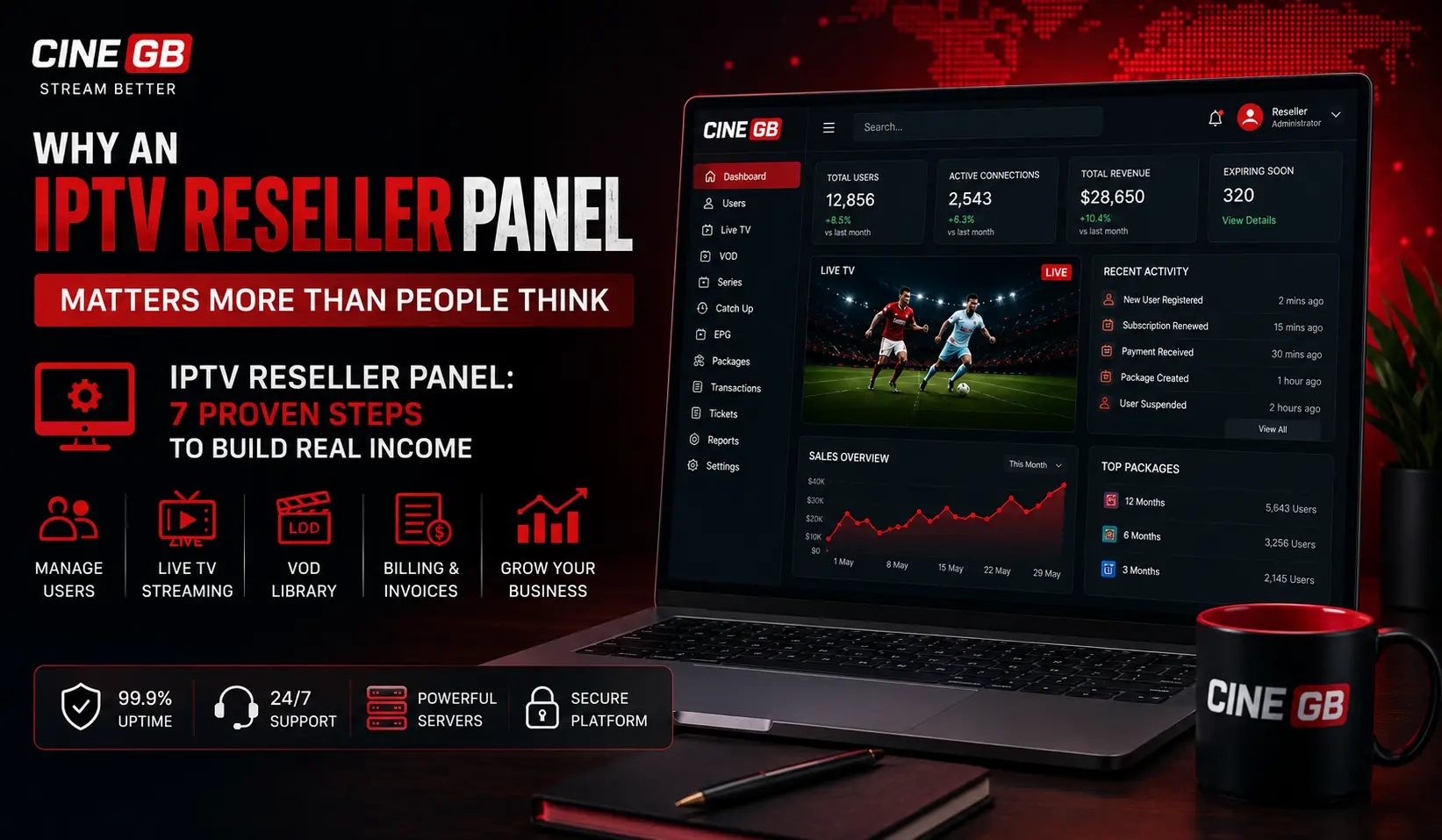
An IPTV reseller panel is the control center of your entire business. It’s where you manage customer accounts, top up credits, monitor server health, and handle renewals. Get it wrong and you’re firefighting support tickets every night. Get it right and the business runs itself while you focus on growth.
What an IPTV reseller panel actually does
At its core, an IPTV reseller panel is a dashboard connected to your IPTV provider’s infrastructure. You buy credits in bulk, then convert those credits into subscriptions for your own customers at whatever price you set. The panel handles account creation, expiry tracking, device binding, and often basic analytics on active users.
Some panels are built on familiar open source style backends. Others use custom infrastructure with their own APIs. The interface might look similar across providers, but the reliability underneath varies wildly. That’s the part beginners rarely check before signing up with a new iptv provider.
Is a fancy dashboard enough to justify the price you’re paying? Not always. A clean interface means nothing if the streams behind it keep buffering.
Before going further, it’s worth being upfront about something. A reseller business only holds up long term if the content being distributed is something you’re actually authorized to resell. Treating this as infrastructure and access management, rather than content distribution, keeps the business on solid ground.
What it actually takes to become IPTV reseller ready
Deciding to become IPTV reseller doesn’t require huge upfront capital, but it does require a realistic plan. You’ll need a panel, a starting batch of credits, a way to take payments, and a rough idea of who you’re selling to. Most people underestimate the support side and overestimate how fast growth will happen.
Anyone serious about this should also think like an IPTV pro from day one rather than treating it as a casual side project. That means documenting your pricing, keeping renewal records tidy, and testing your own service the way a customer would before you ever advertise it.
The credit system, explained simply
Every IPTV reseller panel runs on some version of a credit economy. You purchase a batch of credits from your provider, often in packs of 25, 50, or 100. Each credit typically converts into one month of service for one customer, though some providers offer multi month credit options at a discount.
Pricing on credits usually scales with volume, though the exact structure varies a lot by provider. A small reseller buying in small batches will often pay more per credit than someone who commits to a larger monthly purchase, but the gap depends entirely on that provider’s tier structure.
Here’s an illustrative scenario rather than a hard statistic. Imagine a reseller who keeps buying credits ten at a time out of caution, staying reactive instead of planning ahead. Over a year, that pattern can easily push the effective cost per customer noticeably higher than what a committed monthly buyer pays. Cash flow discipline matters, but so does understanding the unit economics of your IPTV reseller panel before you scale.
Choosing the right IPTV provider and panel for your business
Not every panel or iptv provider suits every business model. Some are built for high volume resellers moving hundreds of accounts a month. Others cater to small operators who want a side income with minimal overhead. Matching the panel to your actual scale saves both money and stress.
A few things worth checking before you commit:
- Server uptime history and whether the provider publishes status pages
- Number of available server locations, since geographic spread affects buffering
- EPG (electronic program guide) reliability and update frequency
- Whether the panel supports bulk actions like mass renewals or mass messaging
- Refund or credit rollover policy if a customer cancels early
Reliability, more than interface polish, tends to be what separates resellers who stick around for years from ones who burn out within a few months. That pattern holds up whether you ask experienced operators directly or look at how the industry talks about churn.
If you want the full breakdown of margin math and monthly versus annual pricing, our guide on pricing IPTV reseller subscriptions walks through it step by step.
A comparison of panel tiers
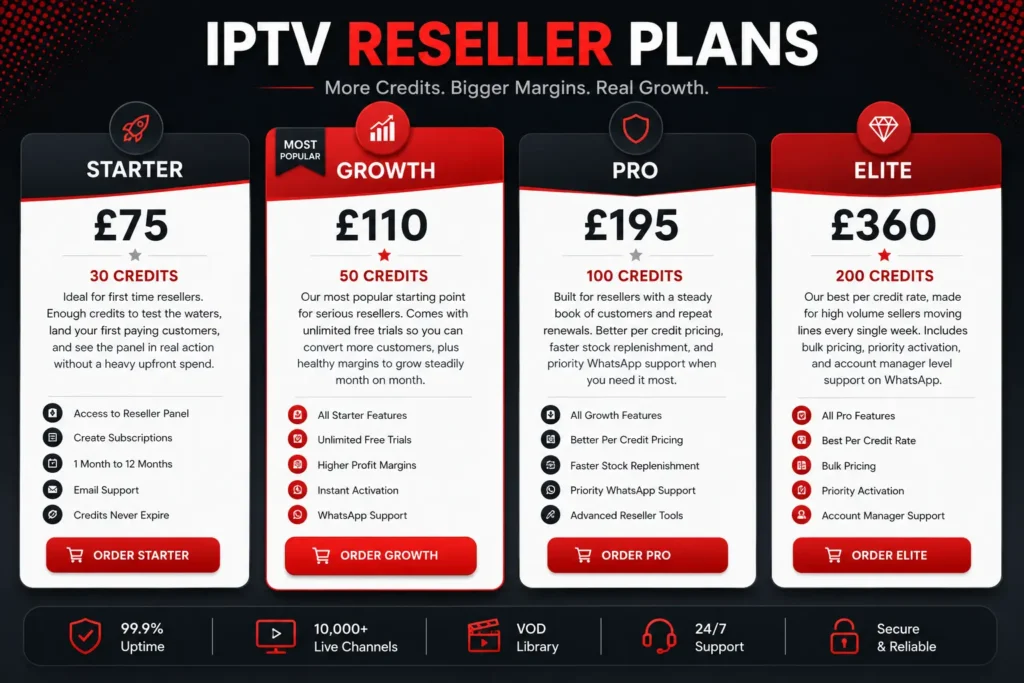
The tier comparison above breaks down customer volume, management features, and who each tier suits best. Higher tiers generally cost more per credit, but they tend to earn that back through fewer buffering complaints and lower churn. Choosing an IPTV reseller panel purely on entry price is a common trap. The real cost usually shows up a few months later in refund requests.
Mistakes that new resellers keep making
The same errors tend to repeat across different resellers, different countries, different customer bases. A few stand out.
- Buying the cheapest panel without checking uptime history first
- Underpricing subscriptions to compete, then having no margin left for support costs
- Ignoring EPG quality, which is often the first thing customers notice
- Failing to track credit expiry, leading to wasted purchases
- Not testing the panel on multiple devices before selling to customers
None of these mistakes are fatal on their own. Stacked together, they’re usually why a reseller quits within six months.
Building the best iptv subscription offer for your customers
Your panel is only half the equation. The other half is packaging what you sell in a way that actually reads as the best iptv subscription option in a crowded market. That means clear pricing tiers, honest device compatibility information, and responsive support when something goes wrong.
Customers rarely compare panels directly, they compare what you offer against two or three other resellers. A slightly higher price is easy to justify if your support responds within hours instead of days. An IPTV pro operator treats that responsiveness as part of the product, not an afterthought.
Pricing your subscriptions the smart way
Pricing an IPTV reseller panel’s output, meaning the subscriptions you resell, is part art and part math. Your cost per credit sets the floor. Everything above that needs to cover support time, refunds, and marketing.
- Calculate your true cost per credit including any provider fees
- Add a margin that accounts for churn and support time, which can vary widely by market
- Check what competitors in your region charge for comparable service
- Offer tiered pricing, such as monthly, quarterly, and annual plans
- Reassess pricing every quarter as credit costs shift
Margins vary a great deal depending on provider, region, and what a credit actually includes, so treat any specific percentage you see online as a rough starting point rather than a fixed rule. What matters more is checking your own numbers against local competitors every few months.
Our guide on IPTV panel customer support best practices covers how to budget support time into that pricing.
Getting your IPTV reseller panel launch ready
Before you open the doors to paying customers, a short readiness check saves a lot of grief later.
- Confirm recent server uptime history with your provider
- Test streams across at least three different device types
- Set up a clear refund and replacement policy in writing
- Prepare a simple onboarding message for new customers
- Have a backup iptv provider identified in case your main panel goes down
Skipping this step is how resellers end up with angry customers in the first week. Taking an extra day here almost always pays for itself.
Frequently Asked Questions
What exactly do I need to start with an IPTV reseller panel?
You need a provider account, an initial batch of credits, and a way to accept payments from customers. Most providers set you up with panel access within a day of signing up. You’ll also want a basic understanding of how credits convert into subscriptions before you start selling.
How much does an IPTV reseller panel typically cost?
Credit pricing varies significantly by provider, region, and volume commitment, so there’s no single number that applies everywhere. Higher tier panels with more server locations and better redundancy generally cost more per credit than entry level options. It’s worth requesting current pricing directly from a few providers before comparing.
What’s the difference between a regular iptv provider and a reseller panel?
A provider supplies the actual streaming infrastructure and content access, while the panel is your management layer on top of that access. Some companies act as both, others separate the two roles entirely. Understanding which one you’re dealing with matters when something breaks and you need to know who to contact.
How do I know if I’m offering the best iptv subscription compared to competitors?
Compare device compatibility, EPG quality, support response time, and pricing side by side with two or three local competitors. Price alone rarely wins long term, reliability and support usually matter more to customers who stay subscribed. Ask existing customers directly what would make them switch away, and address that first.
Is it worth switching IPTV reseller panels if I’m unhappy with support?
If support response times are consistently slow or unhelpful, switching is often worth the short term disruption. Plan the migration during a low demand period and notify customers in advance. Losing a few customers during a switch usually beats losing them gradually to a bad experience.