Contact Us

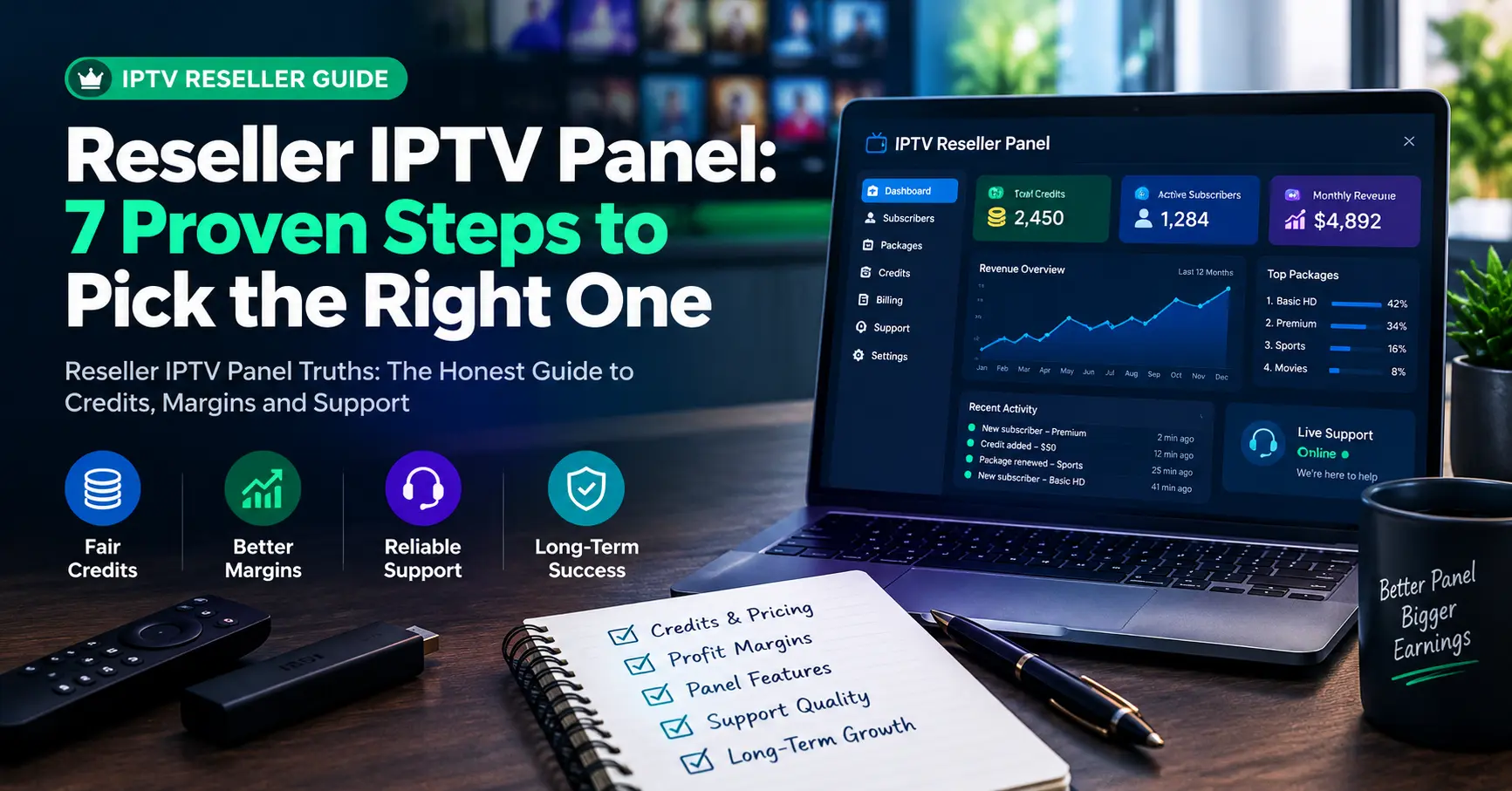
Reseller IPTV Panel Truths: The Honest Guide to Credits, Margins and Support
Three years ago, a mate of mine rang me at ten past eight on a Saturday night. Forty of his customers had lost their channels at once, the football was about to kick off, and he had no idea who to call.
He’d signed up to a reseller IPTV panel because the price looked brilliant. What he hadn’t done was ask who sat behind it, how the credits worked, or what would happen when something broke. I’ve watched that story repeat itself more than once, and it’s the reason I’m writing this.
If you’re weighing up life as an IPTV reseller, this is the guide I wish he’d read first. We’ll cover what a panel really is, how to size up an iptv provider, and where the money genuinely comes from. I’ll also point out the trade-offs that most sales pages quietly skip.
What a Reseller IPTV Panel Actually Does
Strip away the jargon and a reseller IPTV panel is really just a dashboard. It sits between you and the upstream iptv service, and it lets you create accounts, set expiry dates, assign packages and track credits without emailing anyone every time.
Think of it as a till and a stockroom rolled into one. You buy credits in bulk from your provider, then spend them one at a time as you activate or renew subscribers. The panel handles the bookkeeping, and you handle the people.
Most panels share the same core tools. You’ll typically find:
- One-click line creation and renewal
- Package and bouquet assignment for each customer
- A credit balance with a full transaction history
- Sub-reseller management if you want a small team beneath you
- Simple reports on active, expired and trial lines
Notice what’s missing from that list. A panel doesn’t create content, and it can’t repair a weak stream. It only manages access to whatever your upstream source delivers, so the quality of that source decides almost everything.
Shared Panels, White Label Panels and Everything Between
Panels come in a few flavours. A shared panel is hosted by your provider and usually looks like everyone else’s. A white label version lets you put your own name and branding on the login page, which costs more but makes you look like a proper business rather than a middleman.
Apps matter here too. Your customers will probably watch through something like TiviMate, IPTV Smarters Pro or VLC, and the panel generally produces the login details those apps need. Check that your provider supports the players your customers already use, because nobody wants to install a clunky app just to watch the news.
The Licensing Question Nobody Wants to Answer
Here’s the uncomfortable bit, and I’d rather say it plainly. A big slice of the cheap IPTV market runs on unlicensed streams, and reselling those can land you in genuine legal trouble. In the UK, the Federation Against Copyright Theft has pursued sellers of illicit streaming services, and Ofcom has published research on how widespread illegal streaming has become.
Before you touch any reseller IPTV panel, ask your provider a blunt question. Which broadcasters and rights holders have licensed the content you’re about to sell? A legitimate iptv provider will answer that without flinching, and a vague reply is an answer in itself.
I’m not a solicitor, and the rules differ from country to country, so please get proper legal advice for your situation. What I can tell you is that licensed routes exist. They’re smaller and pricier than the grey market, but they’re far safer.
What does a licensed route look like in practice? Usually it means official apps, regional broadcasters and wholesale deals with a paper trail. The channel count is lower and the cost per credit is higher, but you get invoices, contracts and a business you could comfortably explain to your bank.
Is the thinner margin worth it? In my experience, yes. A business that can’t be shut down overnight is worth far more than a fat margin that vanishes.
Reputation matters here as well. If an upstream seller disappears, every customer you’ve signed up still expects you to fix things, and they know your name, not the supplier’s.
How to Judge an IPTV Provider Before You Pay
Vetting a provider works a bit like hiring a plumber. You don’t judge on the quote alone. You check references, you ask awkward questions and you look at the van.
Start with a trial. Any serious iptv service will hand you a short test line, usually for 24 to 48 hours. Use it during peak hours, because a stream that looks perfect at 2pm can crumble at 8pm on a match night.
Next, check the footprint. Is there a named company, a support address and a set of clear terms? Look for reviews on Trustpilot and independent forums, and read the negative ones first, since the one-star complaints show how a business behaves under pressure. For a fuller checklist, read our piece on choosing a reliable iptv provider.
Then test the human side. Open a support ticket about something trivial and time the reply. If a simple question takes three days, imagine the wait when your entire customer base drops out.
Red Flags Worth Walking Away From
Some red flags are loud. No trial line, no named company, payment only by methods you can’t trace, and promises of every channel on earth for a few pounds a month all belong in that group. Quiet ones count too, like support that goes silent the moment your money lands. Any one of these might be forgivable, but two or three together should make you close the tab.
Last spring I signed up for trial lines with three different providers for a friend’s side project. Two answered my test ticket within an hour. The third took five days and then asked me to pay first, and guess which one had the cheapest price list?
Seven Features a Reseller IPTV Panel Must Have
Once the provider passes your checks, look at the software itself. A good reseller IPTV panel should feel boring in the best way: fast, predictable and clear. Here’s my short list.
- Clear credit tracking. Every credit spent should be logged against a named customer, with a date.
- Reliable bulk actions. You’ll want to renew or extend dozens of lines at once without the page timing out.
- Trial and expiry controls. Short trials, automatic expiry and easy extensions keep your records honest.
- Sub-reseller permissions. If you grow, you’ll want to limit what other users can see or change.
- Branding options. Your own logo and domain make a real difference to how customers see you.
- Security basics. Look for two-factor authentication, IP restrictions and activity logs.
- Mobile-friendly design. You’ll manage lines from your phone far more often than you expect.
Security deserves a second look. Your panel holds customer details and payment history, so a weak login is a real risk. I’d walk away from any reseller IPTV panel that can’t offer at least two-factor authentication.
Not every feature suits every business. A solo reseller with thirty customers doesn’t need sub-reseller tiers. Pick what fits your size today, and check that upgrading later won’t mean starting from scratch.
Credits, Pricing and Real Margins Compared
Money is where most new resellers get a shock. Credits usually map to a month of access for one connection, and the price per credit drops as you buy bigger bundles. The table below is an illustrative example, not a quote from any provider.
| Bundle | Credits | Cost per credit | Your retail price | Gross margin per line |
|---|---|---|---|---|
| Starter | 10 | £6.00 | £10 | £4.00 |
| Growth | 50 | £5.00 | £10 | £5.00 |
| Volume | 100 | £4.20 | £10 | £5.80 |
Those margins look healthy until you subtract everything else. Payment fees, support time, the occasional free month to calm a grumpy customer and refunds all chip away at them. I’d budget to lose ten to fifteen percent of the gross figure before calling any of it profit.
Picture a small example. Say you run fifty lines at £10 each, and your cost lands near £5 per credit. That’s £250 gross a month, perhaps £200 once the extras bite, which makes a decent side income but not a salary.
No reseller IPTV panel changes that arithmetic, though a good one makes the numbers much easier to see.
Negotiation is possible too. Providers often discount for resellers who commit to steady monthly volume, so ask politely rather than assuming the price list is fixed. Just don’t sign up for a six-month bundle until the trial has proved itself.
Support, Uptime and the Stuff That Breaks at 8pm
Streams fail, and that isn’t cynicism. Servers overload, upstream sources drop and home routers misbehave at the worst possible moment.
Your job as an IPTV reseller is to work out where the fault sits before anyone panics. Is it the source, the panel, the customer’s app or their broadband? Most of the time it’s one of the last two, and a calm checklist saves hours.
My routine is simple. I ask which channels fail, whether it’s one device or all of them, and whether a speed test shows stable broadband. If you want a fuller process, our guide on IPTV Troubleshooting Without the Guesswork: Find the Real Cause in Minutes walks through it step by step.
Uptime promises deserve some scepticism. A provider claiming 99.9 percent should be able to explain how they measure it. Ask for a status page or a history of past outages, and see whether they’re honest about them.
A reseller IPTV panel that shows live server status inside the dashboard is a quiet sign of a mature operation. It means the provider expects problems and has planned for them. That honesty is worth more than a flashy sales page.
Communication is half the fix. When something goes wrong, tell customers before they ask, even if the message is only “we know about it and we’re on it.” Silence breeds anger far faster than a short outage ever will.
Running Your IPTV Reseller Business Week by Week
Your First Month With a Reseller IPTV Panel
Let me sketch what a sensible first month looks like. Week one is for testing, so run the trial lines yourself on three or four devices, including a cheap Android box and a smart TV, because that’s where odd bugs hide.
Week two belongs to a handful of friendly customers who’ll give you blunt feedback. Week three is for paperwork, meaning terms of service, a refund policy and a simple way to take payment. By week four you’ll know whether you enjoy the support side, which matters more than most people admit.
Keep your records tidy from day one. A spreadsheet works at first, and the credit log inside your reseller IPTV panel should match it line for line. If the two disagree, find out why straight away.
Tools make life easier. A basic helpdesk or even a shared inbox keeps requests from getting lost, and a payments tool such as PayPal or Stripe handles recurring billing with proper receipts. Ask your provider whether the panel can send expiry reminders automatically, because that one feature saves hours.
Set your support hours early. If you answer messages at midnight once, people will expect it forever. A polite auto reply saying when you’re back keeps you sane and keeps customers informed.
Customer retention is where small resellers win. Reply quickly, explain outages honestly and remind people before their expiry rather than after. A friendly message saying their plan ends on Friday does more for loyalty than any discount.
Mistakes I See New Resellers Make Again and Again
After years of watching newcomers, the same errors keep surfacing. The first is buying a huge credit bundle before testing anything, which locks you into a provider you haven’t proven.
Underpricing is the next one. Rock-bottom prices attract customers who leave the moment someone else is cheaper, and they flood your inbox while they’re here. Charge a fair price and you’ll attract people who value stability.
Another mistake is promising what you can’t control. Telling customers that every match will always play perfectly is a promise nobody can keep. Be honest about the limits, and you’ll build trust faster than any slogan.
Finally, there’s the single supplier trap. Put every customer on one upstream source and one outage becomes your outage. Keep a backup iptv service in mind, even if you never use it, and test it quietly now and then.
Treat it like insurance. Any sensible reseller IPTV panel strategy includes a plan B before you need one.
Is This Business Actually Right for You?
Reselling isn’t for everyone, and I’d be doing you a disservice if I pretended otherwise. You’ll field messages in the evenings and at weekends, which is exactly when people watch television. If you hate customer service, a reseller IPTV panel will simply be an expensive way to feel stressed.
On the other hand, if you enjoy solving problems and talking to people, it can be rewarding. You build a small community, you learn a lot about streaming technology, and you control your own hours more or less. Just go in with open eyes about licensing, costs and workload.
Ask yourself three things. Do you have the time, the patience and the appetite for proper legal due diligence? If any answer is no, start smaller or pick a different side project.
Right, that’s the lot. Choose a legitimate source, test it hard, price it fairly and treat every customer as if they were sitting next to you. Do that, and a reseller IPTV panel becomes a tool rather than a gamble.
Open that trial line tonight and watch it during the evening rush. Whatever you see will tell you more than any sales page ever could.
Frequently Asked Questions
What is a reseller IPTV panel and how does it work?
A reseller IPTV panel is a web dashboard that lets you manage customer accounts you’ve bought wholesale from an upstream provider. You purchase credits, then spend them to create or renew lines for your own subscribers. The panel tracks expiry dates, packages and balances so you don’t have to. It doesn’t produce any content itself, so everything depends on the quality and legality of the source.
How much does a reseller IPTV panel cost to start?
Costs vary widely, so treat any figure with caution. Most providers sell credits in bundles, and starter packs can be modest while volume deals reduce the price per credit. Some also charge a monthly fee for white label branding. Ask for the full price list in writing, including renewal costs, before you commit.
Is working as an IPTV reseller legal?
It depends entirely on the content you sell and the country you operate in. Reselling licensed services through proper wholesale agreements is lawful, while selling unlicensed streams can breach copyright law and attract action from rights holders. I’m not a lawyer, so please speak to one before you start. Asking your provider for written proof of licensing is a sensible first step.
How do I choose a trustworthy iptv provider?
Begin with a trial line and test it during peak viewing hours. Check for a named company, clear terms and a support team that replies promptly to a test ticket. Read independent reviews, especially the critical ones. If anything feels evasive, trust that instinct and look elsewhere.
What should I do when customers complain about buffering on my iptv service?
Work out where the fault sits before changing anything. Ask whether it’s one device or several, one channel or all of them, and whether a broadband speed test looks stable. Many cases turn out to be local wifi or an outdated app rather than the source. A written checklist helps you resolve these quickly and keeps your replies consistent.