
Contact Us

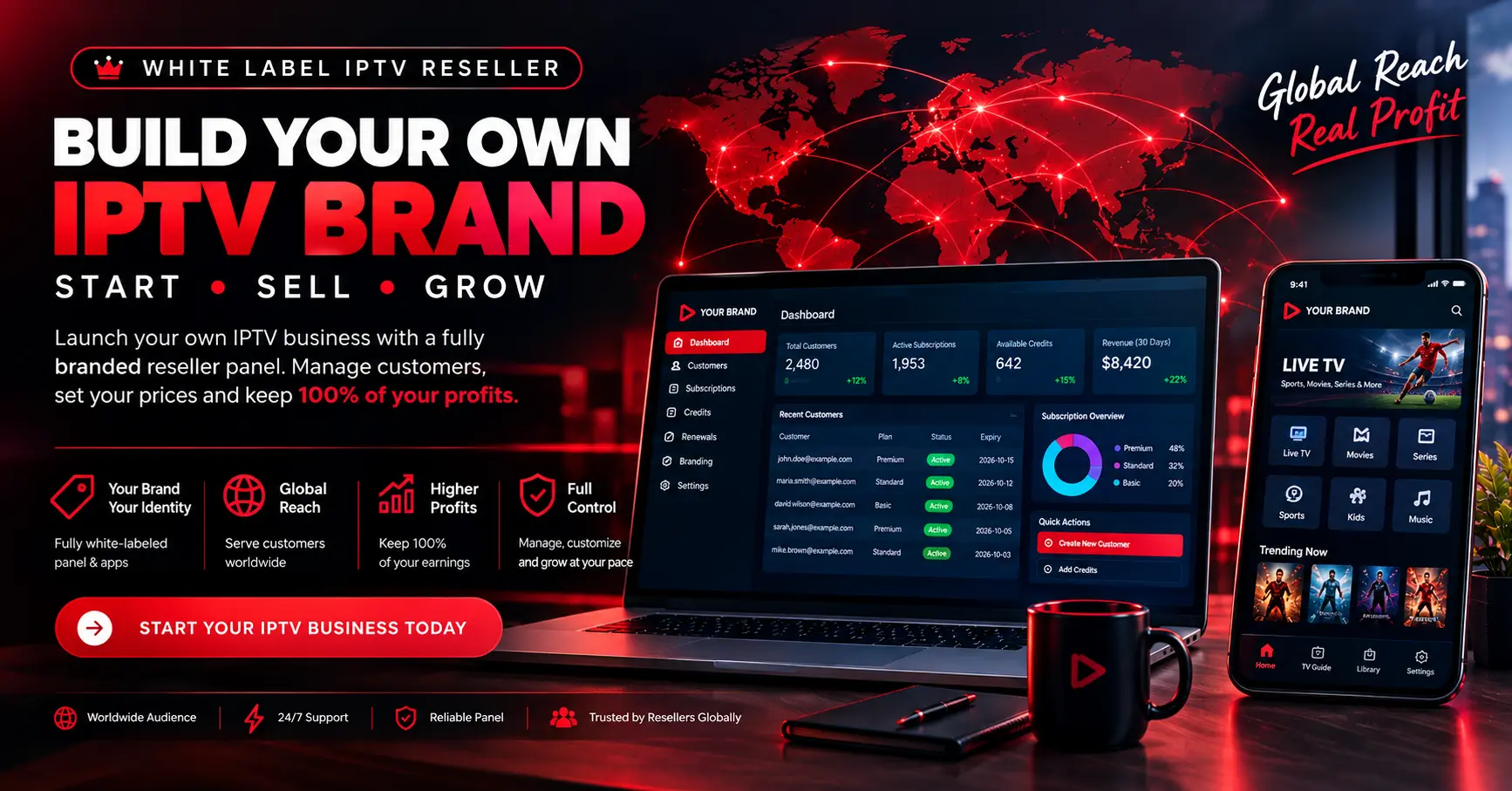
Buy a White Label IPTV Reseller Panel and Sell Under Your Own Brand
Three years ago I sat in a co-working space watching a reseller refresh his sales dashboard every ninety seconds. He had spent eight months undercutting everyone in his niche and had almost nothing to show for it. What finally moved his numbers wasn’t a cheaper supplier. It was a name.
That story is the shortest explanation I can give for why the white label IPTV reseller model exists at all. A white label IPTV reseller buys streaming infrastructure wholesale from a platform provider, then sells access under their own brand, their own domain, their own app skin and their own pricing. The supplier stays invisible. You keep the customer relationship, and with it, the renewals.
Most people arrive at this business from the opposite direction. They start as a plain reseller, sell a few hundred lines, notice their customers keep asking who the “real” provider is, and realise they’ve been building someone else’s asset.
What a White Label IPTV Reseller Actually Sells
Here’s the part that surprises newcomers: you’re not selling streams. You’re selling reliability, presentation and a person who answers messages.
Think of it the way a mobile virtual network operator works. Giffgaff doesn’t own towers. Lebara doesn’t own towers. They own the brand, the billing, the tone of voice and the support experience, and they rent the hard infrastructure underneath. A white label IPTV reseller operates on exactly the same logic, just in a younger and far messier market.
Your supplier handles the panel, the servers, the load balancing and the technical uptime. You handle everything the customer actually sees. That division of labour is the entire value proposition, and it’s why people searching for the best IPTV service rarely know or care which backend powers it.
What sits on your side of the line
- Brand identity, domain and payment flow
- Pricing tiers and promotional structure
- Customer onboarding, setup guides and troubleshooting
- Retention, upsells and renewal reminders
- Reputation management across reviews and forums
What sits on the supplier’s side
- Panel infrastructure and server capacity
- Credit allocation and line provisioning
- Backend uptime monitoring
- API access and reseller tooling
If your supplier is doing any of the first list on your behalf, you’re not running a white label operation. You’re running an affiliate scheme with extra steps.
The Three Layers Nobody Explains Properly
Every functional white label IPTV reseller setup has three layers stacked on top of each other, and confusion between them causes most first-year failures.
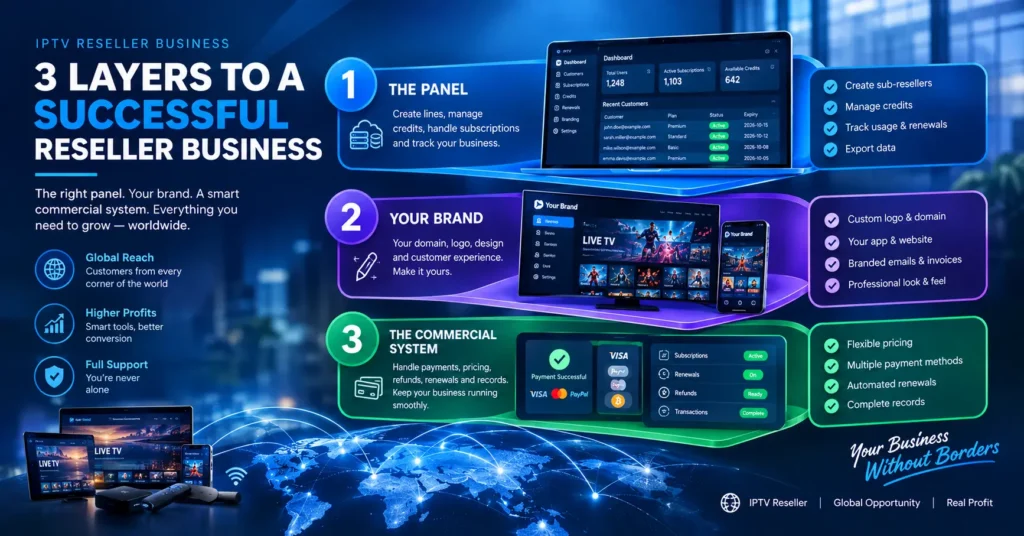
Layer one: the panel
This is where lines get created, credits get deducted and subscriptions get managed. Xtream Codes derivatives still dominate here, and most reputable providers run some variant of that architecture. Your access level matters enormously. A proper reseller panel lets you create sub-resellers, set credit values and export usage data. A stripped-down one just lets you generate lines, which caps your growth almost immediately.
If you’re still weighing up panel access tiers, this breakdown is worth your time:
Buy IPTV Reseller Panel: What You Actually Need to Know Before You Start → / buy iptv reseller panel
Layer two: the brand wrapper
Domain, logo, colour palette, app skin, email templates and invoice design. This is the layer that costs the least and returns the most. I’ve seen two resellers on identical infrastructure, with identical pricing, where one converted at roughly three times the rate of the other. The difference was a proper checkout page and a support email that didn’t come from a free Gmail address.
Layer three: the commercial system
Pricing, payment processing, refunds, renewals and record keeping. This is where most technically capable people stumble, because it’s the least interesting layer and the most consequential one. A white label IPTV reseller who can’t process a payment cleanly loses customers who were perfectly willing to buy.
Money: Margins, Credits and the Cost of Looking Professional
Let’s talk numbers, because vague optimism has ruined more reseller launches than bad infrastructure ever did.
Credits are the currency. You buy a block of credits from your provider, and each subscription line you create consumes a set number depending on duration. Larger blocks cost less per credit. That’s the whole pricing mechanic, and it means your margin improves as your volume grows, not because you negotiated harder but because the arithmetic rewards scale.
A realistic starting picture looks something like this. You buy a mid-sized credit block. Your effective cost per twelve-month line lands somewhere in the low double digits in pounds. You sell that line at three to five times cost, depending on how much support and polish you’re bundling in.
Then the real costs appear. Domain and hosting. A payment gateway that won’t freeze your account. Design work. Time spent answering setup questions at eleven at night. None of that is catastrophic, but it does mean the spread between your credit cost and your sale price isn’t profit. It’s gross margin, and there’s a meaningful gap between the two.
A rough first-year cost picture
| Cost area | Typical range | Notes |
|---|---|---|
| Initial credit block | Low to mid hundreds (GBP) | Bulk purchase lowers per-unit cost |
| Domain and hosting | £60 to £200 per year | Cheap, and no reason to skimp |
| Branding and design | £0 to £500 | Depends on DIY tolerance |
| Payment processing | 2% to 5% per transaction | Varies hugely by processor and risk profile |
| Support time | The hidden one | Budget hours, not pounds |
Notice the last row. Support time is the cost that kills enthusiasm, and almost nobody prices it in. A white label IPTV reseller with three hundred customers is running a small customer service operation whether they planned to or not.
White Label vs Standard Reseller vs Sub-Reseller
These three terms get used interchangeably across forums and sales pages, which helps nobody. The practical differences are sharp.
| Factor | White label | Standard reseller | Sub-reseller |
|---|---|---|---|
| Brand shown to customer | Yours | Usually the supplier’s | Usually the reseller above you |
| Control over pricing | Full | Partial | Limited |
| Customer ownership | Yours | Shared or supplier’s | Rarely yours |
| Setup effort | High | Moderate | Low |
| Margin ceiling | Highest | Moderate | Lowest |
| Suitable for | Long-term brand builders | Testing the water | Casual side income |
Is the white label route right for everyone? Honestly, no. If you want a few hundred pounds a month with minimal commitment, the standard reseller path is faster and less demanding. White label makes sense when you intend to still be trading in three years and you want an asset you can sell or scale.
Why the UK Market Rewards Branding More Than Price
The IPTV UK segment behaves differently from most other regions, and understanding why will save you a lot of wasted effort.
British viewers have grown up with a structured, regulated television culture. Ofcom’s Media Nations research has documented the steady migration from traditional broadcast toward on-demand and streaming viewing year after year, and that shift has produced an audience that’s comfortable with subscriptions but sceptical of anything that looks improvised. Digital TV Research has published similar projections about global streaming subscription growth continuing through the decade.
What does that mean in practice? It means a British buyer comparing options will pay more for the seller who looks legitimate. They’ll read your refund policy. They’ll check whether your site has a contact page. They’ll notice if your payment page redirects somewhere unexpected.
This is precisely where a white label IPTV reseller pulls ahead. When your branding is consistent from advert to checkout to setup email, you’re no longer competing on price alone. You’re competing on trust, and trust is far harder for a competitor to undercut.
The IPTV UK search landscape is crowded with thin, near-identical pages. Standing out doesn’t require a bigger budget. It requires looking like a business rather than a listing.
Seven Steps to Launch Without Wasting Six Months
I’ve watched people take a year to do what could reasonably be done in six weeks. The order matters more than the speed.
- Validate your supplier before you spend on branding. Test the panel yourself. Run lines on multiple devices. Check response times at awkward hours, not just during business hours.
- Choose a narrow audience. A white label IPTV reseller targeting “everyone” converts badly. Targeting a specific language community, a regional diaspora or a particular device ecosystem converts well.
- Register a brandable domain. Short, pronounceable, no hyphens if you can manage it. Avoid anything that dates instantly.
- Build a checkout that doesn’t frighten people. Clear pricing, visible terms, a real contact route. Stripe’s own published research on checkout friction has consistently shown that unclear or overly long payment flows cause significant abandonment, and that finding applies just as forcefully here.
- Write your setup documentation before your first sale. Device guides, common error fixes, a short FAQ. This single step cuts support load dramatically.
- Price for margin, not for volume. The cheapest seller in any niche is usually the most exhausted one.
- Set a review cadence. Monthly check on churn, support ticket themes and credit burn rate. Adjust deliberately rather than reactively.
Step five is the one people skip, and it’s the one that determines whether month four feels manageable or miserable.
Where the Model Falls Apart
I’d be doing you a disservice if I presented this as uniformly straightforward. It isn’t.
Supplier dependency is real. You’ve built a brand on infrastructure you don’t own. If your provider has a bad week, your customers blame you, because your name is on the invoice. That’s the trade you accept in exchange for the margin. Mitigating it means keeping a tested secondary supplier relationship warm, even when you don’t need it.
Payment processing is the recurring headache. Many mainstream processors treat this category as high risk. Accounts get reviewed, held or closed with little warning. Anyone running as a white label IPTV reseller for more than a year will have a story about this.
Support scales badly without systems. Fifty customers is a hobby. Five hundred is a job. Without documentation, canned responses and clear service hours, growth becomes punishment rather than reward.
Regulatory and licensing questions vary by territory. This is genuinely jurisdiction-dependent, and it’s your responsibility to understand the legal position where you operate and where your customers are. Treat any supplier who waves this away as a warning sign rather than a convenience.
Churn is silent. Nobody emails to say they’re leaving. They simply don’t renew. If you aren’t tracking renewal rates monthly, you’ll notice the problem two quarters after it started.
Pro Tips From the Trenches
A few things I wish somebody had told me earlier.
Keep a private credit ledger separate from your panel. Panels change, exports break, and reconciling six months of transactions from memory is genuinely awful.
Answer support messages with a template but sign them with a name. People forgive technical problems far more readily when a human appears to be involved.
Never sell lifetime access. It’s the fastest way to convert future revenue into present-day regret.
Test every promotional claim yourself on real hardware before publishing it. Customers hunting for the best IPTV subscription will test exactly the feature you didn’t check.
Build an email list from day one, even if you never use it. It’s the only asset in this business that survives a supplier change.
Raise prices annually by a small amount rather than dramatically every third year. Nobody churns over a modest increase. Plenty churn over a shock.
If you want a deeper look at how pricing tiers are typically structured across the market, this comparison is useful background:
choose the best IPTV subscription tier → / best iptv subscription
Your Pre-Launch Checklist
For resellers preparing to go live, work through this before you accept a single payment.
- Supplier tested across at least three device types over a full week
- Secondary supplier identified and credited with a small test block
- Domain registered with privacy protection enabled
- Brand assets finished: logo, colour set, email signature, invoice template
- Checkout tested end to end using a real card, not a demo
- Refund and cancellation terms written in plain English and published
- Setup guides written for your three most likely device categories
- Support hours stated publicly and honestly
- Credit ledger spreadsheet created and reconciled once already
- Pricing calculated with processing fees and support time included
- Renewal reminder sequence drafted
- A written answer prepared for “who is your provider?”, because someone will ask
Twelve items. None of them take long individually. Collectively they separate a business from an experiment.
Frequently Asked Questions
How much does it cost to start as a white label IPTV reseller?
Realistically, a serious launch sits somewhere between a few hundred and roughly a thousand pounds, depending on how much design work you outsource. The credit block is usually the largest single line item, followed by branding. Domain, hosting and basic tooling are comparatively minor costs. What people underestimate is the time investment during the first two months, which is substantial even when the cash outlay is modest.
What’s the difference between a white label IPTV reseller and a normal reseller?
A standard reseller typically sells under the supplier’s branding, with limited control over pricing and no real ownership of the customer relationship. A white label arrangement puts your brand, your domain and your support at the front, with the supplier’s infrastructure invisible behind it. The white label route demands more setup work and more ongoing responsibility. In exchange, you keep the margin, the renewals and an asset that has genuine resale value.
Can I run this alongside a full-time job?
Yes, in the early stages, and many people do exactly that. The constraint isn’t the technical work, which is largely front-loaded. It’s support availability, since customers tend to need help during evenings and weekends. Publishing clear support hours and writing thorough setup documentation makes part-time operation entirely workable up to a few hundred subscribers.
How do I know if a supplier is worth building a brand on?
Test before you commit anything. Buy a small credit block, run real lines on real devices for at least a week, and deliberately contact support at an inconvenient hour to see how long a reply takes. Ask specifically whether they offer API access, sub-reseller creation and usage exports. A supplier who can’t answer straightforward technical questions clearly is not a supplier you want carrying your brand name.
Is the market too saturated to start now?
Saturated at the bottom, yes. The low-price, no-brand end of the market is brutally crowded and largely unprofitable. The middle and upper segments, where buyers want reliability, clear communication and someone accountable, remain surprisingly underserved. Competition on presentation and service is far more winnable than competition on price.
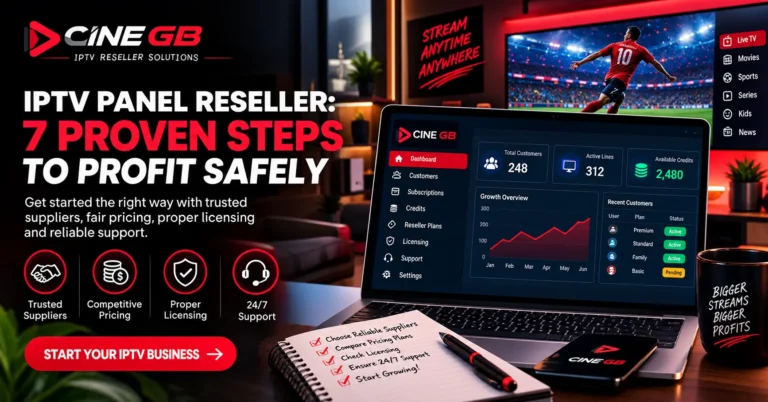
[…] Buy a White Label IPTV Reseller Panel and Sell Under Your Own Brand → / white label iptv reseller […]