
Contact Us

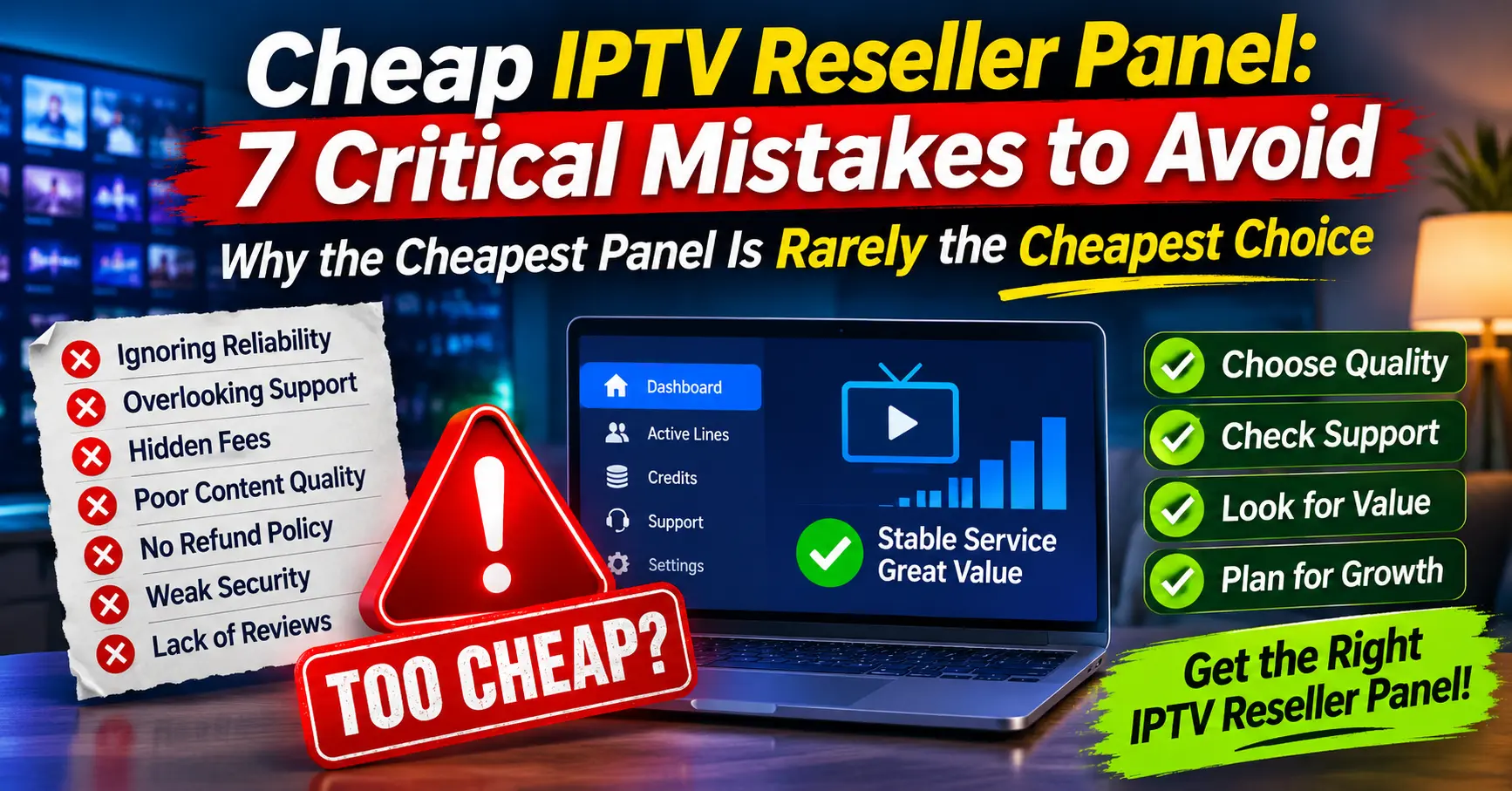
Why the Cheapest Panel Is Rarely the Cheapest Choice
Three years ago, a reseller I’d been advising messaged me at half eleven on a Saturday night. His upstream panel had gone dark, eighty-odd subscribers were furious, and the supplier’s Telegram account had quietly been deleted. He’d picked that cheap IPTV reseller panel because the credits cost about a third of what everyone else charged, and for four months it had felt like the smartest decision he’d ever made.
So is a cheap panel always a mistake? Not automatically. A low price only becomes a problem when it’s hiding something, and in my experience it usually is. This guide covers the seven mistakes I see resellers make when they shop on price alone, how to test a panel before you hand over money, and the situations where going cheap genuinely makes sense.
What a Cheap IPTV Reseller Panel Actually Gives You
Strip away the marketing and a reseller panel is simply a dashboard. You buy credits from an upstream IPTV provider, then spend those credits to create, renew and manage subscriber lines. The panel handles usernames, expiry dates and connection limits, and on better systems it generates the M3U and Xtream Codes login details your customers paste into apps like IPTV Smarters or TiviMate.
What changes at the cheap end isn’t usually the dashboard itself. Plenty of low-cost panels run on the same familiar interfaces as the expensive ones. The differences sit underneath: how many users share each server, how quickly the supplier responds when something breaks, and whether the business behind it will still exist next spring.
That’s why I’d never judge a cheap IPTV reseller panel by its screenshots. A tidy dashboard tells you almost nothing about the IPTV service your customers will actually receive at nine o’clock on a busy evening.
Where the Real Costs Hide
Every reseller I know has, at some point, worked out their margin on the back of an envelope and felt brilliant. Then the refund requests started arriving.
Credit pricing that looks better than it is
Credit pricing is where most of the confusion begins. One credit might equal one month on one panel and one day on another, and some suppliers charge extra credits for multi-connection lines. A panel quoting £0.80 a credit can easily work out dearer than one quoting £2 once you translate both into real subscriber months.
There’s a fuller breakdown, with worked examples, in The Honest Maths Behind Reseller Credits, Panels and Profit → /honest maths reseller credits panels profit. If you’re comparing quotes right now, read that first, because the headline number is almost never the number that matters.
Server load and the peak-time test
Here’s the uncomfortable truth about rock-bottom pricing. Somebody has to pay for bandwidth and server capacity, and if the price is too low to cover it, the supplier makes up the difference by squeezing more users onto each server. You won’t notice at two in the afternoon.
You will notice on a Saturday evening, when everyone’s watching at once and the buffering wheel becomes your customers’ least favourite companion. Overselling is the single most common reason a cheap IPTV reseller panel falls apart, and it rarely shows up during a quick daytime trial.
Support that disappears after payment
Support costs money too, and on a cheap IPTV reseller panel it’s usually the first thing to be cut. Before you buy, they’ll answer in minutes. Afterwards, you might wait two days for a reply about expired lines that won’t renew.
When you’re reselling, their slow support becomes your slow support. Your subscribers don’t care whose fault it is; they only know their stream isn’t working.
The 7 Critical Mistakes I Keep Seeing
These come up again and again, whether I’m speaking to a first-timer or someone running a few hundred lines. Most of them have nothing to do with the panel software and everything to do with how the buying decision gets made.
- Comparing credit prices without converting them. A credit isn’t a standard unit. Always work out the cost per subscriber month before you compare two panels side by side.
- Skipping the peak-hour trial. A daytime test proves very little. Ask for a trial line and use it between seven and ten in the evening, ideally across a weekend.
- Buying a huge credit bundle on day one. Bulk discounts are tempting, but a cheap IPTV reseller panel that disappears takes your unused credits with it. Start small and scale once the supplier has earned your trust.
- Ignoring how the panel is paid for. If a supplier only accepts untraceable transfers and never issues an invoice, ask yourself why. Payment methods with some buyer protection exist for a reason.
- Trusting reviews from the seller’s own channels. Testimonials posted in a supplier’s Telegram group are curated. Look for independent discussion on Reddit or Trustpilot, while remembering that both can be gamed.
- Assuming every device behaves the same. Some panels perform well on Firestick and Android boxes but struggle with MAG devices or Smart TV apps. Test on whatever your customers actually use.
- Forgetting about content rights. This one can hurt you more than all the others combined, so it gets its own section further down.
Notice that only the first mistake is really about price. The rest are about what a low price tends to conceal.
Cheap vs Budget vs Premium: How They Really Compare
Labels like “cheap” and “premium” get thrown around loosely, so here’s how I’d roughly separate the three tiers, based on panels I’ve tested and the resellers I’ve worked alongside. Treat the figures as typical ranges rather than fixed rules, because pricing shifts constantly.
| Factor | Cheap Panel | Budget Panel | Premium Panel |
|---|---|---|---|
| Typical cost per subscriber month | Under £1 | £1 to £2.50 | £2.50 and above |
| Peak-time stability | Often inconsistent | Usually reliable | Consistently strong |
| Support response | Hours to days | Within a few hours | Often under an hour |
| Trial availability | Sometimes | Usually | Almost always |
| Device compatibility | Limited testing | Broad | Broad, with app support |
| Supplier track record | Unknown or short | Established | Long and verifiable |
| Best suited to | Testing the market | Growing resellers | Established businesses |
The middle column is where I’d point most new resellers. A budget panel won’t make you rich overnight, but it leaves enough margin to compete while keeping refunds and complaints manageable. A cheap IPTV reseller panel can still win on margin, as long as you go in with your eyes open and a backup plan ready.
How to Test a Cheap IPTV Reseller Panel Before You Commit
My approach is to treat every new panel like a used car. It might be perfectly fine, but I’m not taking the seller’s word for it, and I’m certainly not paying the full price before I’ve had a proper look under the bonnet.
Step one: get a proper trial
Ask for a 24 to 48 hour trial line, not a ten-minute demo. A reputable IPTV provider will usually offer one without fuss. A refusal tells you something on its own.
Step two: stress it at the worst possible time
Run the trial on your busiest expected evening. Switch between categories quickly, leave a stream running for an hour, and check whether the EPG actually matches what’s on screen. Repeat this on at least two different devices.
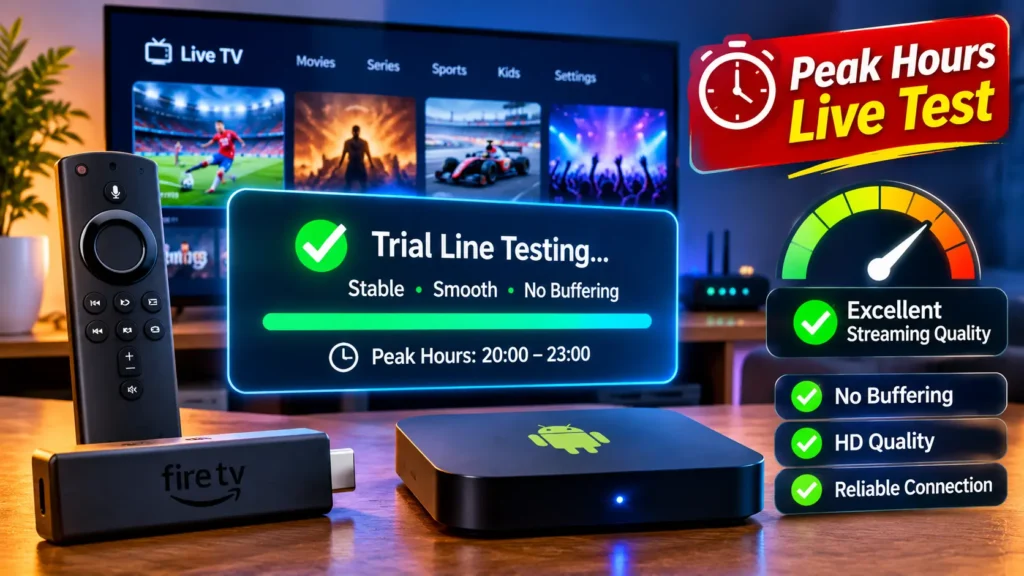
Step three: test the panel, not just the stream
Create a test line, change its connection limit, extend its expiry and then delete it. If any of those basic tasks feel clunky or fail outright, imagine doing them for fifty customers in a single week. The dashboard is where you’ll spend most of your working hours, so it needs to behave.
Step four: message support at an awkward hour
Send a genuine technical question late in the evening and time the reply. It’s a crude test, I’ll admit, but it’s surprisingly accurate. How a supplier treats you before you’ve paid is usually the best they’ll ever treat you.
Once a cheap IPTV reseller panel survives all four steps, I’m comfortable buying a small starter bundle. Not before.
What Your Subscribers Will Notice First
Resellers tend to think in credits and margins. Subscribers think in far simpler terms: does it work when I sit down to watch?
For someone paying for a UK IPTV subscription, three things matter above everything else. They want stability, decent picture quality and problems sorted quickly. They won’t know or care which panel you use; they’ll judge the IPTV service entirely by whether the stream holds up and whether you answer their messages.
Imagine two resellers, each with 60 customers. One saves £40 a month on a rock-bottom panel but loses eight renewals to buffering complaints. The other pays a bit more, keeps almost everyone, and earns referrals along the way.
This is how cheap panels quietly erode a reputation. A customer who buffers twice in their first week rarely renews, and they tell their mates. Replacing a lost subscriber almost always costs more than keeping an existing one happy.
Honestly, the subscriber experience is the real price of your panel. If a cheap IPTV reseller panel saves you money on paper but costs you renewals, your spreadsheet is lying to you.
The Legal Side Nobody Mentions on the Sales Page
Let me be direct here, because this matters more than any discount. A reseller panel is technology that manages accounts and access.
A separate question entirely is the content flowing through it, and that’s the one carrying real legal weight. Software and content rights are two different things, and a supplier selling you the first isn’t automatically licensed for the second.
In the UK, organisations like FACT (the Federation Against Copyright Theft) have pursued sellers of unlicensed streams, and Ofcom has published research on how illegal streaming affects consumers. The Intellectual Property Office also explains copyright infringement clearly on its GOV.UK pages. None of this is scaremongering; it’s simply the environment every reseller operates in.
Extremely low prices can be a warning sign that a supplier isn’t paying for the rights to what it distributes. Before you resell any IPTV service, ask the supplier plainly what content rights they hold and get the answer in writing. If they dodge the question, walk away, however tempting the margin looks.
Put simply, a cheap IPTV reseller panel backed by properly licensed content is a business. One without that backing is a liability with a dashboard attached.
Pro Tips From Resellers Who’ve Been Burned
Nobody gets everything right the first time, myself included. These habits come from mistakes I’ve made or watched others make.
- Keep a written log of every credit purchase, including the date, amount and supplier. If a panel vanishes, you’ll at least know exactly what you lost.
- Never rely on a single upstream IPTV provider. Even a good supplier has outages, and a backup panel lets you move urgent customers quickly.
- If you’re running on a cheap IPTV reseller panel, check upcoming expiry dates weekly so no subscriber gets cut off by surprise.
- Renew your own credit balance a little ahead of time, so a payment delay never leaves customers without service.
- Save your supplier’s support contacts in more than one place. Telegram accounts get banned; a backup email address costs nothing.
- Price each UK IPTV subscription package on the assumption that some customers will need hand-holding. Support time is a real cost, even when nobody invoices you for it.
Pre-Purchase Checklist for Resellers
Before I commit to any cheap IPTV reseller panel, I run through these questions. If I can’t tick most of them, I keep looking.
- The supplier offers a trial of at least 24 hours
- Credit pricing converts clearly into cost per subscriber month
- The stream held up during a peak-time evening test
- Support replied within a reasonable time outside office hours
- The panel lets me create, extend and delete lines without errors
- Lines work on the devices my customers actually use
- The supplier has confirmed in writing what content rights they hold
- Payment comes with an invoice or some form of buyer protection
- I’m starting with a small credit bundle rather than a large one
Is Cheap Ever the Right Call?
Sometimes, yes. If you’re testing whether you can actually sell, a low-cost panel lets you learn without risking much. A handful of friends and family on a starter bundle will teach you more about support, pricing and churn than any guide, this one included.
Where I’d draw the line is scaling on a panel you haven’t stress-tested. Growth magnifies every weakness. Twenty unhappy customers is a bad week; two hundred is a collapsed business.
Personally, I’ll happily start on a cheap IPTV reseller panel if it passes the tests above, but I treat it as a stepping stone rather than a destination. The moment the numbers justify it, I move my best customers onto something sturdier.
Remember the reseller from the start of this piece? He’s still in business, which surprised us both. He rebuilt on a mid-priced panel, kept a cheaper one as a backup, and now tests every supplier for a fortnight before buying a single bundle.
Price, it turns out, was never his real problem. Blind trust was.
One last thought, then. A cheap IPTV reseller panel isn’t good or bad by default; it’s a tool, and like any tool it rewards the person who checks it properly before relying on it. Test hard, start small, ask the awkward questions, and make the panel earn your money rather than the other way round.
Frequently Asked Questions
What is a cheap IPTV reseller panel?
It’s a dashboard that lets you buy credits at a low price from an upstream supplier and use them to create and manage subscriber lines. The software often looks identical to more expensive options. Where it usually differs is server capacity, support quality and the supplier’s long-term reliability. Always judge it on performance during testing rather than on the price alone.
Is a cheap IPTV reseller panel safe to use for a growing business?
It can be, provided you test it thoroughly and confirm what content rights the supplier holds. The biggest risks are overselling, weak support and suppliers disappearing with unused credits. Starting with a small bundle limits how much you can lose. Many resellers keep a cheaper panel as a backup and run their main customer base on a more established one.
How do I know if an IPTV provider is reliable?
Look for a genuine trial of at least a day, consistent performance during peak evening hours and support that replies outside office hours. Independent discussion on sites like Reddit or Trustpilot helps, though you should read it with some scepticism. A supplier that issues invoices and answers questions about content rights openly is a good sign. Vague answers on either point are a reason to keep looking.
How much should I charge for a UK IPTV subscription?
Most resellers work out their true cost per subscriber month first, then add a margin that covers support time, refunds and growth. Undercutting every competitor rarely works, because it leaves no room to fix problems or replace lost customers. Look at what similar resellers charge and position yourself on reliability rather than price alone. Your margin should still make sense if a few customers ask for refunds.
Can I switch panels without losing my subscribers?
Yes, in most cases, though it takes planning. You’ll need to create new lines on the new panel and send each customer fresh login details, ideally before their current lines expire. Clear communication matters more than speed here. Resellers who keep accurate records of every subscriber find the move far less painful than those who don’t.
[…] I’ve covered this in detail in Why the Cheapest Panel Is Rarely the Cheapest Choice → /why the cheapest panel is rarely the cheapest choice, and it’s worth reading before you spend a penny on […]