
Contact Us

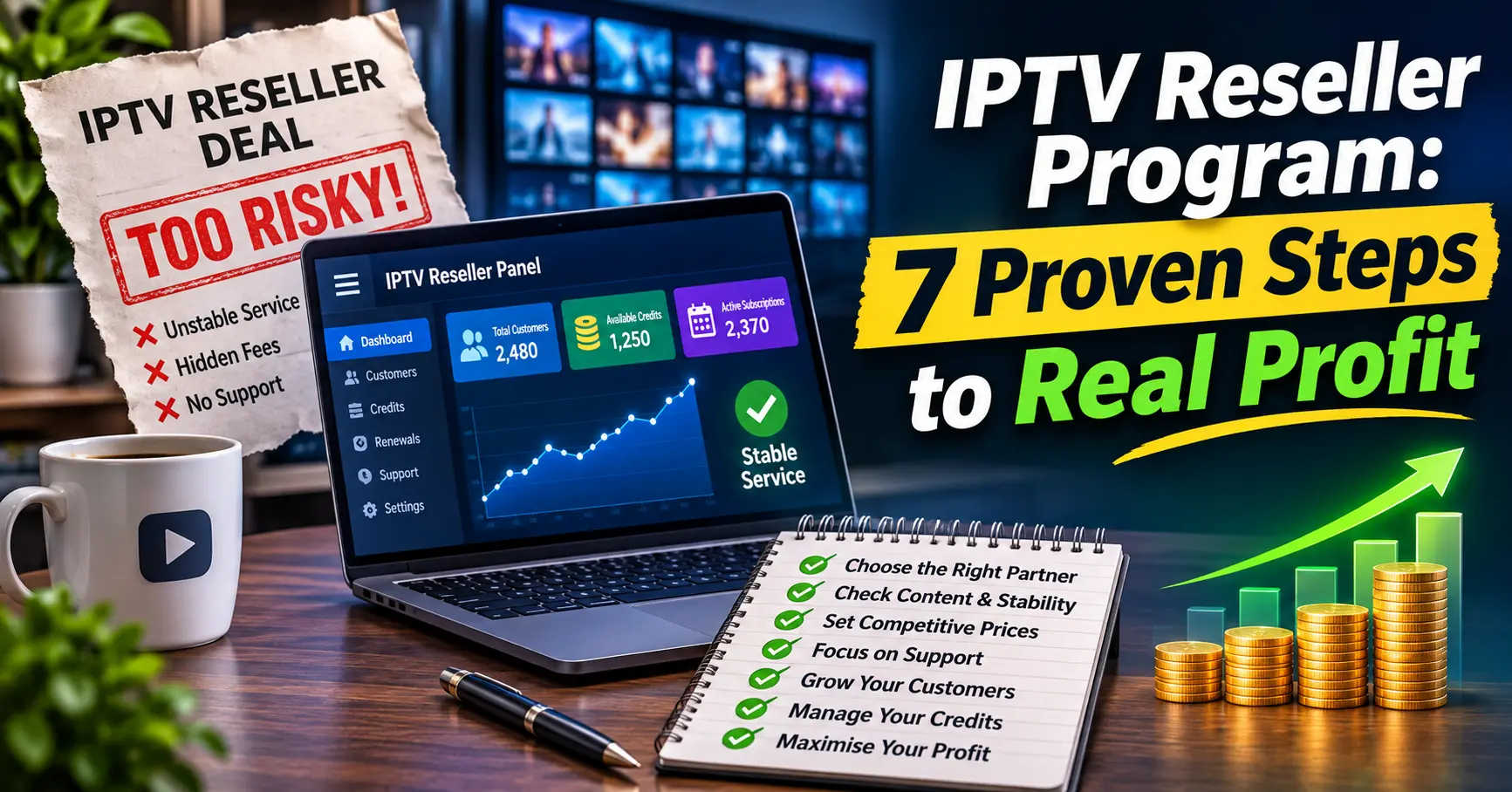
The Reseller Deal I Almost Signed, and What It Taught Me
Three years ago, a friend in Walsall rang me at half eleven on a Sunday night, absolutely furious. He’d joined an IPTV Reseller Program on the strength of a slick landing page, sold forty subscriptions in a fortnight, and watched half his customers ask for refunds after one bad weekend. His question was simple: was the whole model broken, or had he just picked the wrong partner?
Short answer? The model works, but only when the wholesale IPTV provider behind it is stable, the panel is honest about credits, and you price for support rather than for volume. A good IPTV Reseller Program gives you technology, a dashboard and a margin. It doesn’t give you a business, and that part is still yours to build.
What an IPTV Reseller Program Really Hands You
Strip away the marketing and every IPTV Reseller Program sells you the same three things. You get access to a reseller panel, a stock of credits bought at wholesale rates, and the ability to create and manage subscriber lines under your own name. Everything else, from branded apps to support scripts, is an add-on that varies wildly between suppliers.
Credits are the currency. Most panels price one credit as one month of a single connection, though some handle multi-connection lines differently, so read the conversion table before you assume anything. You buy credits in blocks, often with a bigger discount the larger the block, and spend them each time you create or renew a customer.
What you don’t get matters just as much. A wholesale supplier rarely handles your customers’ questions, refunds or device headaches. That job lands on you, usually at the least convenient hour of the week.
Reseller access versus sub-reseller access
Some versions of an IPTV Reseller Program let you create your own sub-resellers, who buy credits from you rather than from the supplier. It sounds like passive income. In practice it doubles your support load, because every sub-reseller’s customer problem eventually becomes yours.
My honest view is that newcomers should ignore sub-reseller features for at least the first three months. Learn the dashboard, learn your customers, and add layers only once the base is calm.
My Weekend Stress Test for Any IPTV Panel
Sales pages are written on quiet Tuesday afternoons. Real customers turn up on busy weekend evenings, when half the country seems to be streaming the same live event at once. That gap is where most reseller businesses crack, so it’s exactly where I test.
Before I commit serious money to any IPTV panel, I buy the smallest credit block available and create two or three test lines. Then I watch them closely across one full weekend, using the apps my customers actually use. In the UK that’s mostly IPTV Smarters Pro and TiviMate on Fire TV Sticks, plus a handful of smart TV apps.
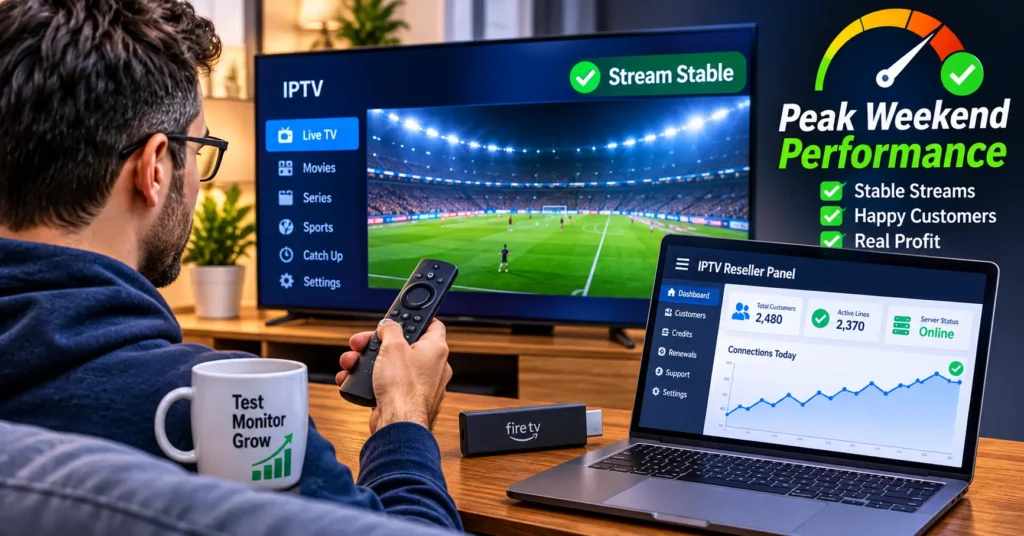
What I measure on the night
- Channel switching speed. If zapping between live channels takes longer than three or four seconds at peak, customers will notice before you do.
- Buffering frequency. One short stall in an evening is tolerable. Repeated freezing during the busiest hour points to a supply problem, not a home Wi-Fi problem.
- EPG accuracy. A programme guide that’s out of sync makes the whole IPTV service feel cheap, even when the streams themselves are fine.
- Catch-up and on-demand response. I open three or four on-demand titles to see how quickly they start playing.
- Support reply time. I deliberately message the supplier at peak time and note how long a human takes to answer.
Write the results down. A simple note of times and symptoms gives you something concrete to compare when you test a second supplier, and memory is terribly unreliable after a long evening of channel-hopping.
Your own connection matters too, of course. Run a quick check with Speedtest by Ookla before blaming anyone else, and if you’re new to diagnosing peak-time drops, I’ve written up the exact routine I follow in Why Your Stream Freezes Every Saturday Night (and How I Finally Fixed Mine) → /why your stream freezes every saturday night
Pro tip: Test on the cheapest device your customers are likely to own, not your best one. An ageing Fire TV Stick on crowded Wi-Fi will expose weaknesses that a wired Shield box hides completely.
The dashboard tells you more than the sales page
Spend an hour clicking around the panel itself. Can you see each line’s expiry date, connection count and last activity at a glance? Can you extend, disable or reset a line in two clicks, or does every change need a support ticket?
Good panels feel boring in the best possible way. Bad ones hide credit deductions, make bulk renewals painful and log you out every ten minutes. You’ll be living in this dashboard daily, so treat its usability as seriously as stream quality.
Credits, Margins and the Maths Sales Pages Skip
Here’s the bit that catches out most first-timers. A supplier might advertise credits at a price that makes a monthly subscription look like pure profit, but the real margin only appears once you subtract refunds, free trials, payment fees and your own time.
Below is a simplified worked example. The figures are illustrative rather than quotes from any particular supplier, because wholesale pricing shifts constantly and depends heavily on volume.
| Item | Budget supplier | Mid-range supplier | Premium supplier |
|---|---|---|---|
| Cost per credit (1 month, 1 connection) | £2.50 | £4.00 | £6.00 |
| Your retail price per month | £10.00 | £12.00 | £15.00 |
| Gross margin per line | £7.50 | £8.00 | £9.00 |
| Typical monthly refund and churn loss | 25% | 10% | 5% |
| Support hours per 100 customers each month | 20+ | 8 to 10 | 4 to 6 |
| Realistic net result | Low and unpredictable | Steady | Steady with room to grow |
Notice how the cheapest supplier looks best in row three and worst almost everywhere else? I’ve seen resellers chase a £1 saving per credit and lose ten times that in refunds after a single rough weekend.
Payment processing deserves a mention too. Card processors and platforms such as PayPal have their own acceptable use policies, so make sure your business and what you sell genuinely fit their terms before you rely on them. A frozen account with a month of takings inside it is a miserable way to learn that lesson.
A sensible rule I give everyone: keep at least one month of expected renewals in credits, plus a cash buffer equal to another month. Running dry on credits during a renewal rush is how you lose customers who were otherwise perfectly happy.
Pricing packages your customers understand
Monthly, quarterly and annual packages each have a role. Monthly lines bring people in, but they churn fastest and create the most renewal admin. Annual packages lock in cash and loyalty, though they also tie you to your supplier for longer, so I only push them once I’ve had three calm months.
Keep the menu short. Three or four options on a simple price page convert better than a sprawling list of connection counts and add-ons, and they make support conversations far easier.
For a deeper look at how credit blocks work inside a typical IPTV Reseller Program, I’ve broken the pricing tiers down separately in IPTV Reseller Credits Explained.
Five Ways an IPTV Reseller Program Quietly Fails
None of these failures arrive with a bang. They creep in over weeks, which is exactly why they’re so dangerous.
Overselling the supplier’s capacity. When a supplier takes on more resellers than its servers can handle, quality drops quietly at peak times first. You’ll hear about it from customers long before anyone admits it.
Silent changes to credit rules. Some suppliers adjust what a credit buys, or change trial policies, with very little notice. A reseller I mentored in Leicester discovered his three-month packages had started costing four credits only after his balance ran out mid-renewal.
Support that disappears after the sale. Pre-sales chat is always lightning fast. What matters is whether the same team answers when you’ve got twenty customers messaging at once and need a server issue confirmed.
Pricing in a race to the bottom. Cutting retail prices to win customers works for about a month. After that you’re stuck with thin margins, price-sensitive buyers and no budget left for decent support.
Ignoring the legal side. Content rights are a genuine issue in this industry, and an IPTV Reseller Program doesn’t transfer any licences just because you bought credits. The UK Intellectual Property Office and Ofcom both publish plain-English guidance worth reading before you sell anything, and a supplier who gets evasive when you ask about rights is telling you something important.
Picking an IPTV Provider You’ll Still Trust in Six Months
Choosing a wholesale IPTV provider feels a bit like hiring a business partner you’ll never meet. You can’t inspect their servers, you probably won’t know their real names, and you’re trusting them with your reputation. So what can you actually check?
Start with longevity. A supplier that’s traded under the same brand for two or three years, with a consistent panel and stable domains, is a safer bet than one that rebrands every few months. Frequent rebrands usually mean something went wrong behind the scenes.
Next, read reviews with a sceptical eye. Trustpilot and reseller forums are useful, but glowing five-star reviews posted in clusters on the same day deserve a heavy discount. I look for the three-star reviews instead, because they tend to describe real trade-offs honestly.
Ask direct questions and judge the answers. How many resellers do they support? What happens to your credits if they migrate servers? Do they offer a test period for the IPTV service before you commit to a large block? Vague replies are a warning, while specific ones, even unflattering ones, build trust.
Don’t overlook the boring logistics either. Does the supplier offer M3U links as well as Xtream Codes logins? Are there backup DNS options if a domain stops resolving on certain broadband networks? These details decide whether a bad night becomes a five-minute fix or a week of angry messages.
Finally, watch how the IPTV provider handles trouble. Every supplier has outages. The good ones post status updates, explain what happened and sometimes credit you back, while the poor ones go quiet and hope nobody notices.
In my experience, the strongest IPTV Reseller Program is usually attached to the most transparent supplier, not the cheapest one.
Who Shouldn’t Bother With This Model
Let me be blunt: not everyone should become a reseller. I’d rather say that plainly than watch someone sink their savings into credits they’ll never sell.
If you don’t enjoy customer service, this probably isn’t for you. A large share of the work is answering messages about remotes, logins and app updates, often late in the evening. People who expect passive income tend to burn out within a few months.
Anyone without a clear audience should also pause. Resellers who do well usually already have a community behind them: a local network, a social following, or a trade they can bundle with, such as aerial installers or small electronics shops. Starting from zero with paid ads is slow and expensive.
Time is the other honest filter. Expect to spend five to ten hours a week in the early months, and more during big live-event weekends when support messages spike. That’s manageable alongside a day job, but only if you plan for it.
And if the legal grey areas make you uneasy, trust that instinct. Consumer groups such as Which? have repeatedly warned buyers about unlicensed streams, and reputational risk falls on the seller first. A legitimate IPTV Reseller Program focused on properly licensed content and the technology layer is a very different proposition from a cheap bundle of unknown origin.
Habits of Resellers Who Last
Over the years I’ve watched dozens of resellers start out, and the ones still trading share a few quiet habits. None of them are glamorous.
- They test before every big weekend. A quick line check on the IPTV panel on Friday afternoon catches problems before the rush.
- They keep their own records. A Google Sheet listing each customer, device, start date and expiry beats relying on the panel alone, and storing it securely in line with ICO guidance keeps you on the right side of UK GDPR.
- They write a setup guide once. A short PDF or screen recording for each common device cuts support messages dramatically.
- They send renewal reminders early. Five days’ notice keeps renewals smooth and avoids the panic of expired lines.
- They never over-promise. Under-promise on uptime and channel counts, then let the IPTV service speak for itself.
- They review their supplier every quarter. Loyalty is fine, but blind loyalty in this industry gets expensive.
A Pre-Launch Checklist for New Resellers
Run through this list before you commit to any IPTV Reseller Program beyond a test amount. If you can’t tick most of it, slow down.
- Tested at least two lines through a full busy weekend
- Confirmed exactly what one credit buys, including multi-connection lines
- Got the supplier’s refund and credit-expiry terms in writing
- Asked the IPTV provider about content rights and saved the answer
- Set retail prices that cover refunds, payment fees and your time
- Prepared device setup guides for Fire TV, Android boxes and smart TVs
- Built a customer record sheet with secure, limited access
- Decided on support hours and published them to customers
- Kept a cash buffer separate from credit spending
One Last Thought Before You Pay for Credits
I think back to that late call from Walsall more often than you’d expect. My friend did eventually build a steady little business, but only after he switched suppliers, raised his prices and started treating support as the product rather than the chore.
That’s the real lesson. An IPTV Reseller Program is a tool, and like any tool it rewards people who test it properly and use it patiently. Pick a supplier you’d be comfortable defending to a customer, price honestly, and give yourself a full season before judging the results. Do that, and you’ll already be ahead of most people who signed up the same week as you.
Frequently Asked Questions
What is an IPTV Reseller Program and how does it work?
It’s an arrangement where a wholesale supplier sells you credits and panel access so you can create and manage subscriber lines under your own brand. You buy credits in advance, usually in blocks, and spend them when you activate or renew customers. The supplier runs the infrastructure, while you handle sales, setup help and day-to-day support. Your profit is the gap between your retail price and your credit cost, minus refunds and expenses.
How much money do I need to start an IPTV Reseller Program?
Most suppliers let you begin with a small credit block, often enough for ten to twenty lines. I’d budget for that block plus a test period and a modest cash buffer, rather than buying the biggest discount bundle on day one. Large blocks only make sense once you know your supplier holds up at peak times. Starting small also limits your exposure if the relationship doesn’t work out.
How do I know if an IPTV panel is reliable?
Test it during the busiest hours, not on a quiet weekday morning. Create a few lines, watch them across a full weekend, and note channel switching speed, buffering and support response times. Check how clearly the dashboard shows expiry dates and credit deductions. A panel that’s easy to manage and stable under load is worth paying a little more for.
Can I leave one IPTV Reseller Program and move my customers to another?
Yes, though it takes planning. Unused credits are rarely refundable, so run your balance down before switching rather than abandoning it. Keep your own customer records outside the panel, because you’ll need them to recreate lines on the new system. Give customers clear notice and fresh setup instructions, and expect a few extra support messages during the move.
Is reselling an IPTV service legal in the UK?
The technology itself is legal, and plenty of businesses sell properly licensed streaming services. The legal risk comes from distributing content without the rights holders’ permission, which can be a criminal matter in the UK. Before selling anything, ask your supplier exactly what rights they hold and read the official guidance from the UK Intellectual Property Office. I’m not a lawyer, so if your situation is unclear, a short consultation with a solicitor is money well spent.
[…] on paper. I wrote about it in The Reseller Deal I Almost Signed, and What It Taught Me → /the reseller deal i almost signed, and the short version is this: the deal that feels urgent is rarely the deal that lasts. Any […]