
Contact Us

Choosing an Internet TV Subscription That Won’t Let You Down
Last winter, a neighbour knocked on my door holding a remote control as if it had personally betrayed him. He’d paid for a full year of internet TV upfront, tempted by a price that looked almost too generous. Three weeks later the service simply stopped. No email, no refund, and nobody answering the support chat.
That’s the honest heart of this guide. An internet TV subscription is television delivered over your broadband rather than a dish or an aerial, and choosing the right one comes down to three things: a stable source, real support, and a price that makes sense over months rather than the first week. Get those right and you’ll wonder why you ever signed a satellite contract.
I’ve spent fifteen years writing about telecoms, and the last several working close to the infrastructure side of streaming. I’ve watched how panels, providers and resellers actually operate behind the curtain, and what follows is the view from that side of the glass. It’s opinionated in places, because you deserve someone who’ll tell you what they’d genuinely do.
The Short Answer, Before the Long One
If you only read one section, make it this one. A good internet TV subscription should feel boring in the best possible way. It works when you switch it on, it doesn’t buffer during the busiest evening hours, and someone replies when something breaks.
Everything else is decoration. Channel counts in the tens of thousands, glossy app screenshots and “lifetime” deals are marketing, not substance. Stability and accountability are the real product you’re buying.
You might think that sounds too simple. Perhaps it is, but in my experience the people who get burned are almost always the ones who judged a service on the size of its menu instead of the quality of its kitchen.
How an Internet TV Subscription Actually Reaches Your Screen
Most people picture a single company beaming pictures straight to their television. The reality has a few more layers, and understanding them makes you a far sharper buyer.
The Provider, the Reseller and You
At the top of the chain sits the IPTV provider, the business that runs the servers, manages the streams and keeps the whole operation online. Below them you’ll often find an IPTV reseller, someone who buys access in bulk, usually as credits on a management panel, and sells individual accounts to viewers like you.
Neither arrangement is automatically better. A direct IPTV provider may offer tighter technical control, while a good IPTV reseller often gives faster, more personal help because they look after a smaller group of customers. The question isn’t who sits where in the chain; it’s whether the person you pay can actually fix a problem when it lands.
Why Your Broadband Matters More Than the Price Tag
Here’s something sellers rarely mention. Your own connection is half the experience, and no IPTV service on earth can outrun a struggling router tucked away in the back bedroom.
For a single HD stream, I’d want a steady 15 to 20 Mbps as a minimum, and 25 Mbps or more if you plan to watch in 4K. Wired Ethernet beats Wi-Fi almost every time. If three people are streaming at once on a modest fibre package, even the best plan in the world will stutter during the evening rush.
The Devices in the Middle
Your screen is the last link. Most services work across smart TVs, streaming sticks, Android-based set-top boxes, phones and tablets, usually through a dedicated app or a compatible player.
Older smart TVs can be the weak spot. Their processors age badly, their app stores stop receiving updates, and a stream that plays perfectly on a cheap streaming stick may judder on a five-year-old television. Before blaming your internet TV subscription, it’s worth testing the same account on a second device.
Price Is a Terrible Compass
This is where most buyers trip, and honestly, I understand why. When two offers look identical on paper, the lower number feels like the clever choice.
But price only tells you what you pay on day one. It says nothing about what you’ll spend in time, frustration and replacement plans when a bargain service collapses. I’ve watched this pattern repeat so often that I now treat an unusually low annual fee as a warning rather than a perk.
Roughly speaking, here’s how the three tiers I come across most often tend to behave in practice:
| What you’re judging | Bargain-bin plans | Mid-range plans | Premium plans |
|---|---|---|---|
| Stability at peak times | Unpredictable | Generally steady | Consistently strong |
| Support response | Often none | Within a day | Within hours |
| Free trial offered | Rarely | Usually | Almost always |
| Refund or credit policy | Unclear or absent | Written, sometimes limited | Clear and written |
| Long-term value | Poor | Good for most homes | Best for heavy viewers |
None of this is a law of nature. You’ll find solid budget options and disappointing premium ones. Still, the pattern holds often enough that I’d rather pay a little more for a service with a history than gamble on one with nothing but a price.
What “Cheap” Really Costs Over a Year
Picture two households. One pays a rock-bottom fee for a year upfront, and the service fails in month four. They then buy a second plan, which lasts until month nine, and finally settle on a third. Add it up and they’ve paid for three subscriptions, wasted countless evenings, and still ended the year with a service they don’t fully trust.
Meanwhile, the second household pays a fair monthly fee for a well-run internet TV subscription from the start. Their total for the year is often lower, and they’ve spent precisely zero evenings on hold. Which of those two would you rather be?
Monthly, Quarterly or Annual?
Billing length deserves more thought than it usually gets. Annual plans look tempting because the per-month figure drops, sometimes by a third or more, and sellers know that headline saving is hard to resist.
Personally, I earn the discount first. Pay monthly until a service has survived a few busy evenings, a weekend of heavy viewing and at least one support query, then move up. A quarterly internet TV subscription is a sensible halfway house, giving you a modest saving without tying a year’s money to a seller you’ve only just met.
Annual billing does have its place. If you’ve been with the same provider for six months or more, nothing has gone wrong, and the refund policy covers outages, locking in a lower rate is perfectly reasonable. Just don’t let the first week’s enthusiasm make that decision for you.
Seven Questions I Ask Before Paying for Any Internet TV Subscription
Whenever a friend asks me to sanity-check a service, I run through the same short list. It takes about ten minutes and has saved more than one person from a costly mistake.
- Is there a genuine free trial? A 24 to 48 hour trial lets you test the IPTV service at the times you actually watch, which is the only test that really counts.
- How quickly does support reply? Send a simple question before you buy. If it takes two days to answer a prospective customer, imagine how long it’ll take once they’ve got your money.
- Which devices are supported? Check that your smart TV, streaming stick or set-top box is covered, and ask whether there’s a proper app or only login details for a third-party player.
- How many connections are included? One connection usually means one screen at a time. Families tend to need two or three.
- Is there a written refund or credit policy? If it isn’t in writing, assume it doesn’t exist.
- How long has the seller been operating? A track record of a year or more tells you far more than any glowing testimonial.
- Does the IPTV provider hold the rights to what it streams? This one matters more than people realise, and I’ll come back to it shortly.
Question seven tends to make people shift in their seats. Isn’t that the seller’s problem rather than mine? Partly, yes, but a service built on content it has no right to distribute is a service that can vanish overnight, taking your annual payment with it.
My advice is simple. Choose an internet TV subscription from a seller who can explain, in plain language, where their content comes from and what happens to your money if the service stops.
The Warning Signs I’ve Learned to Respect
Not every poor internet TV subscription announces itself. Some look polished and professional right up until the day they disappear. Over the years, though, I’ve noticed that the troublesome ones share a handful of habits.
Lifetime deals are the first. Nobody can promise to run servers forever for a one-off fee, and the maths simply doesn’t add up for any honest business. When I see “lifetime access” on a sales page, I close the tab.
Pressure tactics come next. Countdown timers, “only three slots left” banners and discounts that expire within the hour are designed to stop you thinking. A trustworthy IPTV service is happy for you to take your time, run a trial and come back when you’re ready.
Payment methods tell their own story too. If a seller will only accept untraceable methods and offers no invoice or receipt, you’ve got very little recourse if things go wrong. I’m not saying every small seller needs a card terminal, but some kind of paper trail should be the bare minimum.
Watch the silence as well. A seller with no visible support channel, no help pages and no way to reach a human before purchase is telling you exactly how they’ll treat you afterwards.
Finally, be wary of impossible numbers. A plan promising every channel from every country, in perfect 4K, for less than a takeaway coffee each month is selling a fantasy, and fantasies don’t come with customer service.
A Word for Anyone Thinking of Becoming an IPTV Reseller
Some readers arrive at this subject from the other side of the counter. You’ve watched friends pay for an internet TV subscription and wondered whether you could offer it yourself, perhaps as a side business.
It’s a fair question, and my answer is: possibly, but go in with your eyes open. An IPTV reseller is really running a small customer service operation. You buy credits from a panel, create accounts, handle renewals and, above all, answer the messages when a customer’s stream drops on a Saturday night.
Plenty of newcomers buy from whichever panel looks cheapest, then try to undercut everyone else on price. I’ve seen that plan fail more times than I can count, usually because the cheap source proves unstable and the reseller ends up refunding half their customers. I’ve covered this in detail in Why the Cheapest Panel Is Rarely the Cheapest Choice → /why the cheapest panel is rarely the cheapest choice, and it’s worth reading before you spend a penny on credits.
Support is where your reputation lives. Customers forgive the odd outage if you tell them quickly and honestly what’s happening; they rarely forgive silence. If you can’t commit to answering messages in the evenings and at weekends, this probably isn’t the right side business for you.
Rights matter here even more than they do for viewers. As a seller, you carry responsibility for what you offer. A sensible IPTV reseller separates the technology (panels, apps and account management) from the content itself, and works only with an IPTV provider that can show proper permission to distribute what’s on its servers.
Making Your Internet TV Subscription Run Smoothly at Home
Suppose you’ve chosen well. A few small habits will make a noticeable difference to how your internet TV subscription feels from one day to the next.
- Plug in where you can. An Ethernet cable to your TV or streaming box removes the single biggest cause of buffering in most homes.
- Restart your kit weekly. Routers and streaming sticks build up clutter in memory, and a quick power cycle clears it.
- Use the recommended app. Your seller usually knows which player works best with their setup, and their advice beats guesswork.
- Keep everything updated. Updates often fix playback bugs quietly, without anyone announcing them.
- Test before the big night. Got an important match or a season finale coming up? Check everything an hour beforehand rather than five minutes before it starts.
One more tip from personal experience. I once spent an entire evening blaming a perfectly good service for buffering, only to discover a family member was downloading an enormous game update in the next room. Before you fire off an angry message to support, check what else is eating your bandwidth.
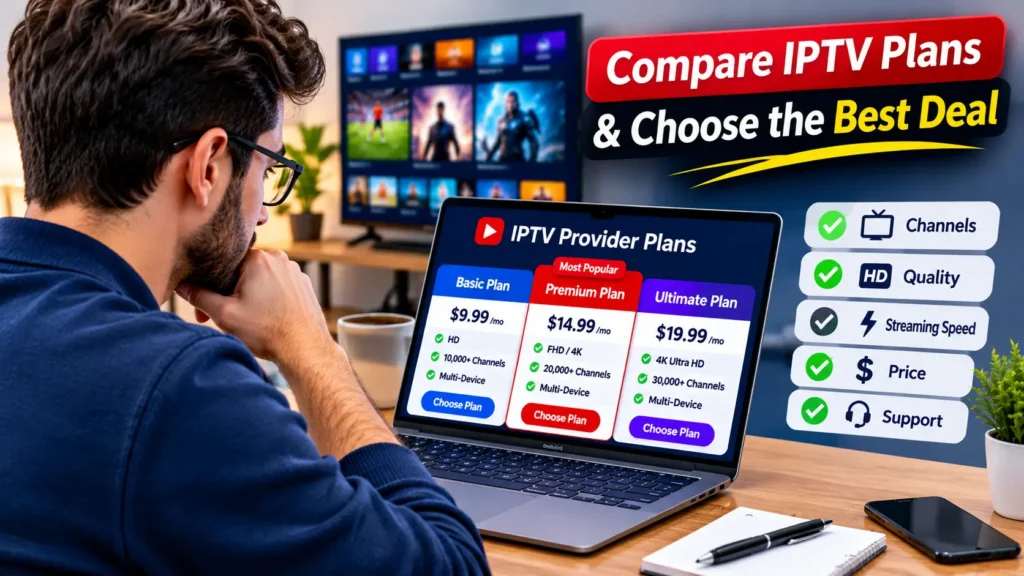
Your Pre-Payment Checklist
Before any money changes hands on a new internet TV subscription, run through this list. If you can’t tick every line, keep looking.
- A free trial was offered, and you used it during your usual viewing hours
- Support answered a pre-sale question within a reasonable time
- Your devices are confirmed as compatible
- The number of connections matches the screens in your home
- The refund or credit policy is written down, and you’ve actually read it
- The seller has a history you can verify for yourself
- The price feels fair rather than suspiciously low
- Your broadband speed comfortably covers the picture quality you want
Where I’d Put My Own Money
So, after all of this, what would I actually do if I were choosing an internet TV subscription tomorrow?
I’d start with short trials from two or three services, all tested on the same busy evening. I’d pay monthly for the first couple of months, even if annual billing looked cheaper, because trust should be earned before it’s paid for in bulk. Only once a service had proved itself through a few hectic weekends would I commit to a longer plan.
Is that slower than grabbing the first bargain you find? Absolutely. It’s also how you avoid becoming the person at the neighbour’s door with a remote and a grievance.
Keep notes, too. A simple record of when buffering happens, which device you were using and how long support took to reply turns a vague feeling into evidence. If you ever need to ask for a credit, or decide whether to renew, those notes will make the choice for you.
Streaming is changing quickly, and the services that last will be the ones that treat support and reliability as the product rather than an afterthought. Choose one of those, look after your home connection, and your internet TV subscription will quietly earn its place in the monthly budget. That, really, is the whole point.
Frequently Asked Questions
What is an internet TV subscription?
An internet TV subscription is a paid service that delivers live television and on-demand content over your broadband connection instead of a satellite dish or aerial. You usually watch through an app on a smart TV, streaming stick, set-top box, phone or tablet. Most plans are sold monthly, quarterly or annually. The quality you get depends on both the service itself and the speed and stability of your home connection.
Is an internet TV subscription cheaper than satellite or cable?
In many cases it is, mainly because there’s no installation, no dish and often no long contract. That said, the cheapest option isn’t always the best value over a full year. A service that fails and needs replacing can end up costing more than a fairly priced, reliable one. Compare the total cost over twelve months, not just the headline monthly fee.
What’s the difference between an IPTV provider and an IPTV reseller?
Think of an IPTV provider as the source: it runs the servers and manages the streams. An IPTV reseller buys access from a provider, often as credits on a panel, and sells individual accounts to viewers. Resellers frequently handle setup, renewals and day-to-day support. Either can be a good choice, provided they’re reliable, responsive and transparent about their policies.
How fast does my broadband need to be for an IPTV service?
A single HD stream usually needs a steady 15 to 20 Mbps. For 4K, aim for 25 Mbps or more per screen. If several people stream at once, add those figures together and leave some headroom. A wired Ethernet connection will almost always give you a more stable picture than Wi-Fi.
Can I cancel an internet TV subscription if it stops working?
It depends entirely on the seller’s refund or credit policy, which is why you should read it before paying. Reputable services usually offer a written policy covering outages, credits or partial refunds. If no policy exists, your options may be very limited. Paying monthly at first is a sensible way to reduce your risk while you build trust in a new service.
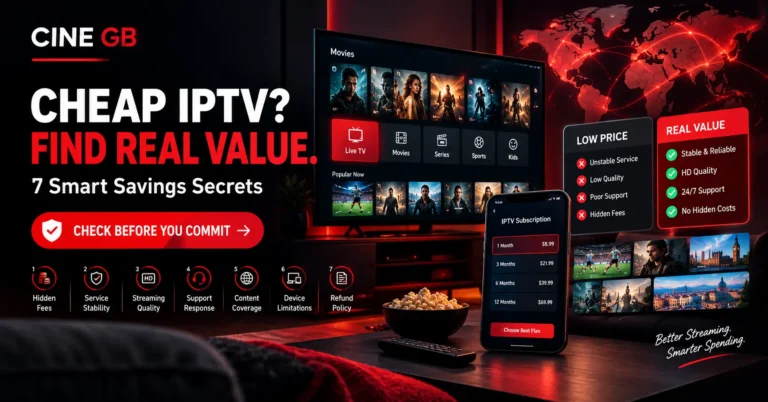
[…] comparing sellers, my guide to Choosing an Internet TV Subscription That Won’t Let You Down → /choosing an internet tv subscription walks through it step by […]