
Contact Us

The Honest Guide to Buy Premium IPTV: Licensing, Pricing and Support Explained
Picture a Saturday evening, a full sofa and a cup final that freezes just as someone steps up to take a penalty. I’ve lived that moment, and I’d bet you have too. It’s the reason I started testing streaming services properly, and it’s why anyone planning to buy premium IPTV deserves a straight talking guide instead of a sales pitch.
Here’s the thing. A premium IPTV service isn’t a magic box that unlocks every channel on earth for pocket change. It’s a delivery method, television sent over the internet, and the quality depends on who runs it, who licenses it and who answers when it breaks.
Over the next few sections I’ll walk through what to check before you buy premium IPTV, what to avoid and what fair pricing looks like. If you’re curious about the business side, there’s a section on reselling too. I’ll also tell you where I think the whole market is heading.
Why So Many People Want to Buy Premium IPTV Right Now
Cable bills crept up for years. Then streaming apps multiplied, and keeping up with sport, news and drama suddenly meant five separate subscriptions. Viewers started asking a fair question. Is there one tidy service that brings it all together?
That’s the pull of IPTV. Live channels, on-demand libraries and catch-up shows arrive through an app on a smart TV, an Amazon Fire TV Stick or a phone. There’s no dish, no aerial and no engineer on your roof.
Most people who want to buy premium IPTV are after three things. They want dependable live sport, a wide channel mix and a picture that doesn’t stutter at eight o’clock on a Friday night. Those are reasonable expectations.
The catch is that the market is crowded and wildly uneven. Some iptv providers are properly licensed broadcasters or distributors. Others are anonymous storefronts that vanish after a month and take your money with them.
I’ll be blunt about that gap, because it’s where most of the heartbreak happens. Knowing how to spot the difference is worth more than any discount code.
What “Premium” Should Actually Mean
Premium is a word that gets stuck on everything from crisps to car insurance. So let’s give it a proper job.
A premium IPTV service should meet a handful of measurable standards:
- Stable streams with an uptime promise, ideally in writing
- HD and 4K options that hold their quality during busy hours
- A tidy electronic programme guide, not a jumble of unnamed channels
- Documented rights to the content it sells
- Human support with a stated response time
- A trial or refund policy that doesn’t need a lawyer to decode
Notice what isn’t on that list. A rock-bottom price. Quality costs money to deliver, and the maths rarely works at a few pounds for a whole year.
Years ago I signed up to a service that promised everything for roughly the price of a sandwich. It lasted nine days. The support chat went quiet on day six, and the channel list shrank every evening after that.
The Licensing Question Nobody Likes Asking
Rights are the sore point of this whole industry. IPTV as a technology is perfectly legal and widely used. Telecom operators and broadcasters stream live channels over IP every day, and plenty of well-known apps work on exactly that principle.
Now consider a seller offering thousands of channels, every sports package and the latest films for a tiny monthly fee. Who agreed to that deal? Broadcasters simply don’t hand out wholesale rights at those prices.
Unlicensed streams carry real risk. Services can be shut down without warning, your payment details can end up with careless operators, and in some countries enforcement has reached viewers and sellers alike. The Alliance for Creativity and Entertainment, a coalition of major studios and streamers, has spent years pursuing illegal streaming operations.
Anyone curious about the scale can read the UK Intellectual Property Office’s Online Copyright Infringement Tracker, which is published regularly.
Lecturing isn’t my aim. What I will say is that anyone who wants to buy premium IPTV the safe way should pick a seller that happily explains where its content comes from. If the answer is vague, treat the vagueness as your answer.
Red Flags That Should Stop You Cold
Warning signs often appear before you’ve typed a single card digit. Sellers who refuse to name their business are the biggest one. So are pop-up chats that pressure you with countdown timers and “only three slots left” messages.
Watch the claims too. Promises of “100 percent uptime” or “every channel in the world” are fantasy. Real engineers know servers fail, and real sellers know rights are regional.
Then there’s the payment page. Anything that nudges you towards gift cards, crypto only or bank transfers to a stranger should make you pause. Those routes offer almost no recourse, and scammers love them for exactly that reason.
Last, look at how the seller talks about problems. Healthy businesses speak plainly about outages and fixes. Shady ones either vanish or blame you, your router or the weather.
One more story, if you’ll indulge me. A friend of mine once paid for a “lifetime” plan from a seller with a glossy Instagram page. Lifetime lasted about eleven weeks.
How to Buy Premium IPTV Without Getting Burned
Seven checks have earned a permanent place in my routine. They take about an hour in total, and they’ve saved me and several friends from some ugly experiences.
- Ask for a trial. A short paid trial, even 24 hours, shows you picture quality, channel lists and app stability before you commit to a year.
- Check the payment route. Reputable sellers accept mainstream methods with buyer protection. If you can only pay by untraceable transfer, walk away.
- Read the company details. A real business shows a registered name, a contact address and terms of service. A nickname in a chat window isn’t a company.
- Test at peak time. Try a Saturday evening or a big match night. Anyone can look good at 3am on a Tuesday.
- Look for independent feedback. Forums, Trustpilot and Reddit threads carry useful warnings. Read them sceptically, though, because fake reviews are everywhere.
- Confirm device support. Make sure the service works on your hardware, whether that’s a Fire TV Stick, an Android box, an Apple TV or a Samsung smart TV.
- Get the refund terms in writing. A confident seller has nothing to hide here.
Run through all seven and you’ll weed out most of the rubbish. When you buy premium IPTV, patience is a feature rather than a flaw.
Buy Premium IPTV in Stages, Not All at Once
Start with a one-month plan, even if the annual deal looks tempting. If the service holds up through a busy weekend and a big match night, upgrade then. Annual discounts are only a bargain if the service survives the year.
Does that sound overcautious? Perhaps. But I’d rather lose a few pounds on a monthly plan than a few hundred on a year-long gamble.
Comparing the Main Types of IPTV Providers
Not every seller belongs in the same bucket, so if you’re ready to buy premium IPTV, here’s a rough map. Use it as a starting point rather than a verdict.
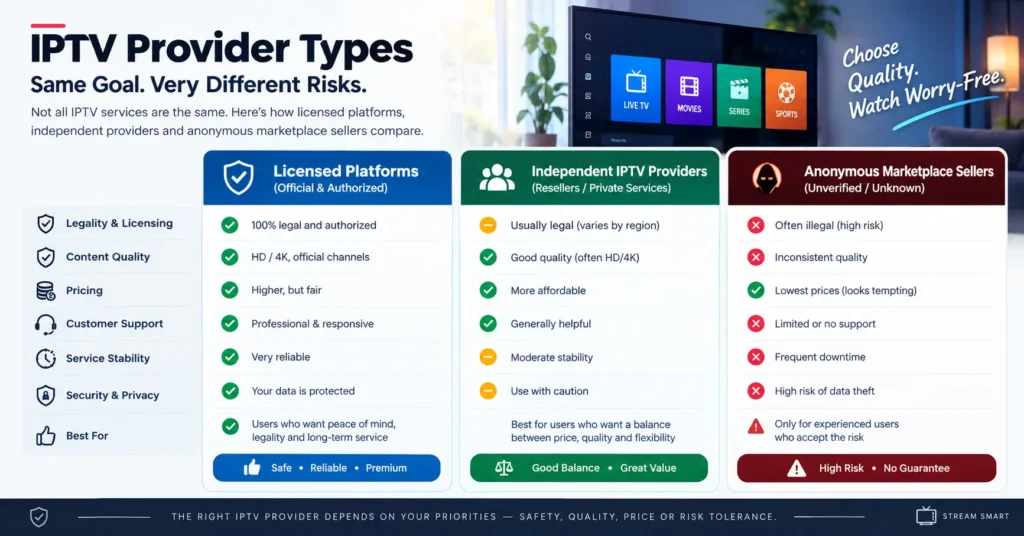
| Provider type | Typical cost | Reliability | Licensing | Best suited to |
|---|---|---|---|---|
| Telecom or broadcaster IPTV | Higher | Very good | Fully licensed | Households wanting zero fuss |
| Licensed live TV streaming platforms | Mid to high | Good | Fully licensed | Sport and news fans wanting flexibility |
| Independent iptv providers | Low to mid | Varies widely | Depends on the seller | Niche language or regional packages, with homework |
| Anonymous marketplace sellers | Very low | Poor and unpredictable | Usually unclear | Nobody, realistically |
No row here is perfect. Licensed platforms cost more and often come with regional restrictions. Independent sellers can offer better variety for particular communities, but you’ll need to do far more homework yourself.
And if you only watch two or three channels, you may not need any of them. Free apps such as BBC iPlayer, ITVX and Channel 4 cover a surprising amount of ground. Premium isn’t always the right answer, and an honest guide should say so.
What I Look For Once the Stream Starts
Paying is only the beginning, so here’s my own test routine. I pick three live channels, one news, one sport and one general entertainment, and watch each for at least fifteen minutes. I’m looking for steady picture quality, clean audio and no random freezes.
Next comes the programme guide. A good electronic programme guide, or EPG, shows accurate listings, correct channel names and sensible categories. A messy one that lists forty channels all called “Sports 1” is a sign of sloppy management.
Latency is worth a mention. Live streams over the internet usually run a few seconds behind broadcast, and with some services it’s much longer. That’s fine for a drama, but it’s maddening when your neighbour cheers a goal before you’ve seen it.
Catch-up and on-demand features get a test too, along with the app’s search function. A clunky app can ruin a perfectly good stream. If you spend ten minutes hunting for a channel, the service isn’t premium in any way that matters.
Pricing: What’s Fair and What Smells Wrong
Think in cost per month, not the headline figure. A twelve month plan at a tiny price looks wonderful until the service folds in month four. Then you’ve paid for eight months of nothing.
Would you hand a year of rent to a landlord you’ve never met? Probably not. Yet people do the equivalent with streaming every day.
Before you buy premium IPTV, set a monthly budget and compare it to what you actually watch. If you only follow one league, a sport-specific licensed pass may beat a giant bundle on value. If the whole family watches different things, a broader package can work out cheaper per head.
Fair pricing from a premium IPTV service usually shows its working, with real support staff, proper servers and a clear account of its content rights. Rock-bottom prices usually mean something got cut. Ask what.
Support and Uptime: The Boring Bits That Save Your Weekend
Suppose it’s the opening weekend of the football season. Your stream drops ten minutes before kick off, and the only way to reach the seller is a chat window nobody answers. Suddenly the discount you were so proud of feels rather expensive.
This is why the best time to test support is before you buy premium IPTV, not after. Send a question about device compatibility or billing and see how long a reply takes. A quick, specific answer from a real person tells you more than any marketing page.
Uptime matters just as much. Ask whether the service uses multiple servers, whether it has a status page and how it handles outages. Honest sellers admit that no platform is perfect, and they’ll tell you what they do when things go wrong.
Your own setup deserves some scrutiny too. A weak Wi-Fi signal causes more buffering than most people realise. A wired Ethernet connection, a decent router and a device made in the last few years fix a surprising number of complaints.
A Word for Anyone Thinking of Becoming an IPTV Reseller
Some readers aren’t just viewers. They’re wondering whether to become an iptv reseller, buying subscription credits from a supplier and selling access on to customers. It can look like easy money, which is exactly why it deserves a cautious look.
Resellers sit in the middle, and that’s an uncomfortable seat. Your customers blame you when streams fail, even if the fault lies with your supplier. You also inherit the supplier’s licensing position, so a shaky upstream can become your problem overnight.
Put these questions to any potential supplier first:
- Who holds the rights to the content you’re supplying, and can you show evidence?
- What’s your uptime record, and how do you compensate for outages?
- How does your panel handle credits, refunds and customer management?
- What’s the support route when my customers need urgent help?
- What happens to my customers if you shut down?
Full details live elsewhere on the site. For suppliers, pricing models, licensing and support, read our IPTV Panel Reseller Guide: Suppliers, Pricing, Licensing & Support → / iptv panel reseller
Honestly, my view is simple. Reselling can work, but only if your supplier is legitimate and you treat support as the real product. Anyone selling a premium IPTV service on thin margins with no support plan is building on sand. Anyone who wants to buy premium IPTV wholesale should apply the same seven checks as an ordinary viewer.
Setting Things Up After You’ve Paid
Once you buy premium IPTV, resist the urge to change every setting at once. Install the recommended app, log in and test a handful of channels in different categories. Check the programme guide, try a catch-up show and watch a live match for twenty minutes.
Speed deserves attention. As a rough guide, HD streams do well with 10 Mbps or more per screen, while 4K usually wants 25 Mbps or more. If several people stream at once, multiply accordingly.
Keep your account details private and use a unique password. Never share login credentials in public forums. Turn on any two-factor option the provider offers, because accounts are valuable targets.
Finally, keep your receipts and screenshots of your plan. If something goes wrong in week three, evidence makes a refund conversation far easier.
Where the Market Is Heading
Broadcasters across Europe and beyond are moving more channels to internet delivery each year. That shift is good news for viewers, because it pushes licensed services to improve their apps, pricing and flexibility.
Enforcement is also getting sharper. Sports leagues and studios invest heavily in tracking illegal streams, which means fly-by-night operators have a shorter shelf life than ever. For buyers, that makes due diligence more valuable.
My prediction is simple. The gap between a properly licensed premium IPTV service and a risky one will keep widening, and viewers will gradually sort themselves into one camp or the other. Which side would you rather be on when the big match arrives?
Before You Hit Pay
Strip away the jargon and this market comes down to trust. The shiny interface, the long channel list and the cheap annual price all matter far less than whether the person on the other end is real, accountable and licensed.
I’d urge you to take your time. Try before you commit, ask awkward questions and remember that the best deal is the one still working next season. Whenever you do buy premium IPTV, do it with your eyes open.
Television is changing quickly, and the viewers who win are the ones who stay curious and a little sceptical. So go and test that trial, send that support question and check those licences. Then settle back on the sofa and enjoy the match.
Frequently Asked Questions
Is it safe to buy premium IPTV online?
It can be, provided you choose carefully. Stick to sellers that show company details, accept protected payment methods and explain their content licensing. Avoid anonymous chat sellers who only accept untraceable transfers. A short trial is the best safety net you’ve got.
How much should I pay for a premium IPTV service?
Prices vary by region, channel mix and licensing. Fully licensed live TV platforms generally cost a noticeable monthly amount, and independent iptv providers often charge less. Extremely low prices are a warning sign because they rarely cover bandwidth, support and rights. Compare the cost per month against what your household really watches.
Can I buy premium IPTV and use it on more than one device?
Usually yes, but connection limits differ. Many services allow one to several simultaneous streams, and extra connections often cost more. Check the limit before paying, especially for a busy household. Also confirm the service has a native app for your particular TV or streaming stick.
What separates good iptv providers from risky ones?
Transparency is the biggest difference. Good providers publish company details, terms, refund policies and clear support routes. They’ll also let you test the service before a long commitment. Risky ones hide behind nicknames, push annual plans hard and disappear when problems start.
Should I become an iptv reseller?
Only after thorough homework. Reselling puts you between your supplier and your customers, so you carry the support burden and some licensing risk. Look for suppliers who can prove their content rights and offer dependable panel tools. If you’re unsure, read a detailed guide to suppliers, pricing and licensing before spending anything.
[…] what’s going through a customer’s head when they decide to buy premium iptv. They’ve compared a few pages, maybe skimmed a review or two, and they’re ready to part […]